
On this page
Top picks at a glance
As an Amazon Associate I earn from qualifying purchases.
- 1
 Victorinox Fibrox 8-Inch9.7/10View on Amazon
- 2
 SYOKAMI 10.5-Inch Breaking9.6/10View on Amazon
- 3
 Mercer Millennia 6-Inch9.6/10View on Amazon
- 4
 Mercer Ultimate White 6-Inch9.6/10View on Amazon
A cutting board covered in venison after a fall hunt calls for the right blade, and the butcher knife vs boning knife choice decides how cleanly the work goes. A butcher knife breaks down large cuts, while a boning knife follows the bone to separate meat cleanly. HarvestGearLab compared listings on each side, using only what each maker publishes.
HarvestGearLab earns a commission when you buy through links on this page, at no extra cost to you. As an Amazon Associate I earn from qualifying purchases. Affiliate disclosure.
Quick verdict: choose a butcher knife for breaking down large cuts into roasts and pieces; the Victorinox example carries an 8-inch curved blade, and the SYOKAMI example carries a 10.5-inch curved blade. Choose a boning knife for separating meat from the bone; each Mercer example carries a 6-inch blade for deboning chicken, ham and fish. A cook who does both jobs ends up with a knife from each side.
What made the list
| # | Product | Harvest Score | Buy |
|---|---|---|---|
| 1 | Victorinox Fibrox 8-Inch | 9.7/10 | Buy on Amazon |
| 2 | SYOKAMI 10.5-Inch Breaking | 9.6/10 | Buy on Amazon |
| 3 | Mercer Millennia 6-Inch | 9.6/10 | Buy on Amazon |
| 4 | Mercer Ultimate White 6-Inch | 9.6/10 | Buy on Amazon |

Victorinox Fibrox 8-Inch
An 8-inch curved Swiss made breaking knife with a high-carbon stainless steel edge, a non-slip Fibrox handle, NSF approval and dishwasher-safe cleaning.
Pros
- 8-inch curved blade made to break down meat into smaller roasts and pieces
- NSF approved and dishwasher safe, with a slip-resistant non-slip grip
- High-carbon stainless steel edge in a lightweight Swiss made knife
- Wider blade adds weight for uniform slicing and helps keep meat from tearing
Cons
- 8-inch blade is shorter than the 10.5-inch SYOKAMI example
- Curved breaking blade is made for slicing roasts, not for working around bones
- Knife sharpeners are sold separately
- No warranty term is stated

SYOKAMI 10.5-Inch Breaking
A 10.5-inch Japanese style breaking knife with a Damascus pattern blade, a full-tang wenge wood handle and a tapered tip the maker says suits boning tasks.
Pros
- 10.5-inch curved blade made to slice flesh, break through cartilage and trim fat from beef, pork and poultry
- 56+ Rockwell hardness with a hand-polished edge
- Triple-riveted full-tang wenge wood handle, FSC-certified wood
- Knife hole design helps measure thickness for a 1-inch thick steak
Cons
- 10.5-inch blade is the longest here and suits large cuts more than close trimming work
- Tapered tip helps with boning tasks, but the wide breaking blade is not a dedicated boning knife
- Dishwasher-safe cleaning is not stated for the wooden handle
- No warranty term is stated

Mercer Millennia 6-Inch
A 6-inch curved boning knife in one-piece high-carbon Japanese steel with a black ergonomic handle shaped with textured finger points.
Pros
- One-piece high-carbon Japanese steel for easy edge maintenance and long-lasting sharpness
- 6-inch curved blade made for separating meat from the bone
- Ergonomic handle with textured finger points for a non-slip grip
- Ideal for deboning chicken, ham and fish, and for trimming fat and sinew
Cons
- 6-inch curved blade suits deboning, not breaking down large roasts
- Hand wash only, with no dishwasher-safe cleaning
- Shorter blade than each butcher example, so it covers less meat in a slice
- Made for deboning chicken, ham and fish, not for portioning steaks

Mercer Ultimate White 6-Inch
A 6-inch boning knife in high-carbon Japanese steel with a white ergonomic handle shaped with textured finger points.
Pros
- High-carbon Japanese steel with a razor sharp blade that lasts
- 6-inch blade made for separating meat from the bone
- Ergonomic handle with textured finger points for a non-slip grip
- Ideal for deboning chicken, ham and fish, and for trimming fat and sinew
Cons
- 6-inch blade suits deboning, not breaking down large roasts
- Hand wash only, with no dishwasher-safe cleaning
- Shorter blade than each butcher example, so it covers less meat in a slice
- Made for deboning chicken, ham and fish, not for portioning steaks
As an Amazon Associate I earn from qualifying purchases.
Runners-up to consider
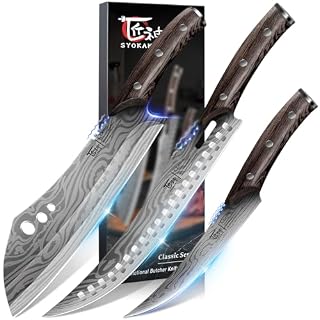 SYOKAMI Butcher Knife SetCheck price on Amazon
 Cutluxe Butcher KnifeCheck price on Amazon
 HOSHANHO Cleaver Knife 7 InchCheck price on Amazon
 Winco 6" Red Plastic Commercial-Grade Boning KnifeCheck price on Amazon
 Huusk Japanese High Carbon Steel Carving Knife with ErgonomicCheck price on Amazon
 Wüsthof Classic 6" Boning KnifeCheck price on Amazon
Butcher knife vs boning knife: side by side
| Knife | Harvest Score | Side | Blade Length | Blade Steel | Handle | Amazon |
|---|---|---|---|---|---|---|
| Victorinox Fibrox 8-Inch | 9.7/10 | Butcher knife | 8 inches | High-carbon stainless steel | Fibrox, non-slip ergonomic | View on Amazon |
| SYOKAMI 10.5-Inch Breaking | 9.6/10 | Butcher knife | 10.5 inches | Damascus pattern, 56+ Rockwell hardness | Wenge wood, full tang | View on Amazon |
| Mercer Millennia 6-Inch | 9.6/10 | Boning knife | 6 inches | One-piece high-carbon Japanese steel | Black, textured finger points | View on Amazon |
| Mercer Ultimate White 6-Inch | 9.6/10 | Boning knife | 6 inches | High-carbon Japanese steel | White, textured finger points | View on Amazon |
Numbers in this comparison come from the maker as the listing shows them, checked 19 November 2026.
What each knife is for
The line between the sides is the cut. Butcher knives in these listings break down meat: the Victorinox example breaks down meat into smaller roasts and pieces, and the SYOKAMI example slices through flesh, breaks through cartilage and trims fat from beef, pork and poultry. Boning knives separate meat from the bone: each Mercer example is made for deboning chicken, ham and fish, and trimming fat and sinew.
The SYOKAMI example crosses the line: its tapered tip maneuvers around bones and joints, so the maker says it suits boning tasks such as filleting fish, deboning poultry and trimming beef or pork. The Victorinox example stays on the butcher side, its curved blade and wider shape made for uniform slicing of roasts. For a related blade, the cleaver vs butcher knife comparison covers the chopping side of the family.
Blade length and curve
Blade length sets the reach of each knife: the SYOKAMI example carries a 10.5-inch blade, the Victorinox example an 8-inch blade, and each Mercer example a 6-inch blade. Longer butcher blades cover more meat per slice.
Curve matters as much as length. The Victorinox, SYOKAMI and Millennia examples each carry a curved blade; the SYOKAMI curve slices through flesh with minimal slicing resistance, and the Millennia curve separates meat from the bone.
Steel, handles and care
Steel differs by maker. The Victorinox example uses a high-carbon stainless steel edge on a Swiss made stamped stainless steel blade. The SYOKAMI example is listed at 56+ Rockwell hardness with a hand-polished edge and a Damascus pattern blade. Each Mercer example uses high-carbon Japanese steel, and the Millennia example is made in one piece.
The Victorinox example carries a textured Fibrox handle with a non-slip grip, even when wet, shaped to help minimize tension at the wrist. The SYOKAMI example carries a triple-riveted full-tang wenge wood handle, with FSC-certified wood that absorbs oil and moisture. Each Mercer example carries an ergonomic handle with textured finger points for a non-slip grip; the Millennia handle is black and the other Mercer handle is white.
The Victorinox example is dishwasher safe. Each Mercer example asks for hand washing with warm water and mild soap, a rinse and a full dry, and warns against the dishwasher and long soaking. The SYOKAMI example states no dishwasher-safe cleaning, so hand care is the safe reading.
Gaps to check
No example here states a warranty term. Only the Victorinox example carries a stated approval, NSF. Only the SYOKAMI example states a hardness figure, 56+ Rockwell, and only it comes with a gift box. The white Mercer example gives its weight as 0.04 pounds, which does not fit a 6-inch steel knife.
Which should you choose?
Choose a butcher knife if the job is breaking down large cuts and the cook wants a long curved blade. The butcher knife uses guide shows what each blade shape is made for, and the best butcher knife set guide compares high-carbon sets.
Choose a boning knife if the job is separating meat from the bone and the cook wants a short blade that follows the bone. The what a boning knife is for guide covers its uses, and the boning knife size guide matches length to the job.
Whichever side fits, keep a sharpener close by; the Victorinox maker names its own sharpeners, sold separately, and the whetstone vs knife sharpener comparison covers the choice.
In the Preserving Kitchen
- Wash each Mercer knife by hand with warm water and mild soap, then rinse and dry it.
- Run the Victorinox knife through the dishwasher; the maker lists it as dishwasher safe.
- Wipe the SYOKAMI wenge wood handle dry after washing; the maker says the wood absorbs oil and moisture.
- Keep the SYOKAMI gift box for storing the 10.5-inch blade.
How the Harvest Score played out
| Product | Harvest Score | Perf. /35 | Build /25 | Value /25 | Safety /10 | Warranty /5 |
|---|---|---|---|---|---|---|
| Victorinox Fibrox 8-Inch | 9.7 | 30 | 22 | 21 | 8 | 0 |
| SYOKAMI 10.5-Inch Breaking | 9.6 | 30 | 21 | 20 | 9 | 0 |
| Mercer Millennia 6-Inch | 9.6 | 29 | 21 | 21 | 7 | 0 |
| Mercer Ultimate White 6-Inch | 9.6 | 28 | 20 | 21 | 7 | 0 |
Harvest Scores sit on a narrow band from 9.2 up to 9.8. Each tool’s weighted points are converted onto it proportionally, and a higher total always gives a higher number.
The Harvest Score weighs performance, build, value, safety and warranty. For knives, safety covers stated features that keep the grip sure and the blade under control: the NSF approval and slip-resistant grip on the Victorinox example, the four safety designs on the SYOKAMI example, and the textured finger points on each Mercer example. The Victorinox example scores highest on its NSF approval, dishwasher-safe cleaning and balanced build; the SYOKAMI example follows on its 56+ Rockwell hardness and full-tang handle. No example earns warranty points, since no example states a term. How we pick explains the weights.
FAQ: preserving at home
Which knife breaks down large cuts of meat?
A butcher knife: the Victorinox example carries an 8-inch curved blade for breaking down roasts, and the SYOKAMI example a 10.5-inch curved blade for slicing flesh and trimming fat.
Which knife works around bones and joints?
A boning knife: each Mercer example carries a 6-inch blade for separating meat from the bone, and the SYOKAMI example adds a tapered tip for bones.
Can a butcher knife do boning work?
The SYOKAMI example can help: its tapered tip suits boning tasks such as filleting fish and deboning poultry. The Victorinox example stays on the butcher side.
How long are the blades in this comparison?
The SYOKAMI example measures 10.5 inches, the Victorinox example 8 inches, and each Mercer example 6 inches.
Which knives can go in the dishwasher?
Only the Victorinox example, listed as dishwasher safe. Each Mercer example asks for hand washing, and the SYOKAMI example states no dishwasher-safe cleaning.
More preserving guides
See every meat processing guide and all game and fish processing guides.
More picks: meat processing knife sets, German steel butcher knife sets, skinning knife vs boning knife and fish fillet knives.