
On this page
Top picks at a glance
As an Amazon Associate I earn from qualifying purchases.
- 1
 Hokuvory Electric Butter Churn with 34 oz Glass Jar and9.6/10View on Amazon
- 2
 IFOLO Electric Butter Churn9.5/10View on Amazon
- 3
 Butter ChurnView on Amazon
- 4
 KILNER Butter ChurnView on Amazon
- 5
 Buttermeister Butter ChurnView on Amazon
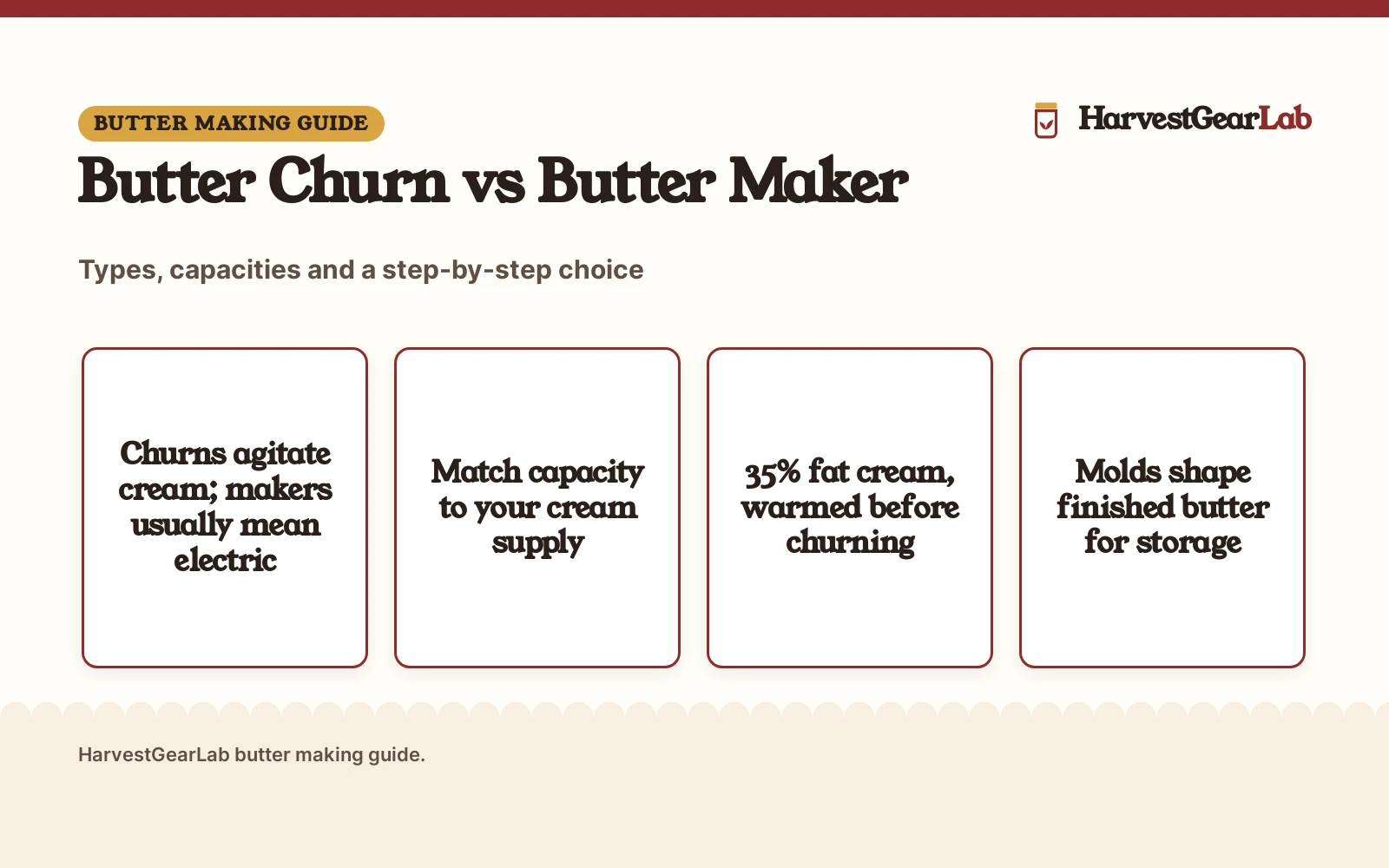
The butter churn vs butter maker question is really about two names for the same job. A butter churn is the classic tool that agitates cream until it separates into butter and buttermilk; a butter maker is the same idea under a modern name, usually an electric one-touch appliance, and sometimes the mold that shapes finished butter. This guide explains the types, what the listings state about capacity and time, and how to choose, step by step.
Runners-up to consider
 Electric Butter Churn One-Touch Butter Maker Ready in 5-15Check price on Amazon
 Butter ChurnCheck price on Amazon
 KILNER Butter ChurnCheck price on Amazon
 Buttermeister Butter ChurnCheck price on Amazon
HarvestGearLab earns a commission when you buy through links on this page, at no extra cost to you. As an Amazon Associate I earn from qualifying purchases. Affiliate disclosure.
Butter churn vs butter maker: the types
Manual churns work by hand crank or by dash: a cranked paddle in a glass jar, or a vertical plunger in a wooden barrel. The RDGDFONG listings describe a 51 oz hand-crank mason jar churn with a wooden handle, stainless steel gear and silicone blade at 11 by 6 by 12 in, making butter in minutes with one listing stating a 3-month warranty. The CAROD listing describes a 1.5 L (50 oz) hand-crank churn at 4.7 by 5.5 by 12.4 in with a hand-injury prevention device and an 18-month warranty. The Eiqijci listing describes a wooden dash churn of 3 L (3.2 qt) with a 30 cm barrel and removable 40 cm plunger, churning in 8 to 15 minutes for about 320 to 450 g of butter per batch.
Electric butter makers work at the push of a button. The Kigmmro, Hokuvory and Palvo listings each describe a 34 oz glass jar electric churn: Kigmmro at 5 to 10 minutes and 2.1 lbs, Hokuvory at 5 to 15 minutes and 3.5 lbs with a 2-year warranty, and Palvo at 5 to 10 minutes and 3 lbs with a 2-year warranty. Larger electric models go further: the ZEosonor lists a 50 oz cordless churn with an 8000 RPM brushless motor, a 6000 mAh battery good for about 7 to 10 uses, taking up to 40 oz of heavy cream per batch in 15 minutes; the Tormiv lists a 61 oz jar with a 10,000 RPM brushless motor and a 3 to 10 minute range at 2.7 lbs. The UIRNCO listing is the third type, a butter maker as mold: a silicone mold at 6.8 by 5.7 by 1.3 in, 6.72 oz, with a 16 oz capacity, a lid and two spatulas, BPA-free.
How to choose, step by step
Decide how you want to churn
Hand churns need no power and suit small batches and the homestead feel; the Eiqijci dash churn works best with about 0.9 to 1.1 L of heavy cream per batch. Electric makers suit frequent use: press a button and wait 5 to 15 minutes, per the listings. For the manual-vs-powered tradeoff, our electric vs hand crank butter churn comparison covers both.
Match capacity to your cream
Capacities run from 34 oz to 61 oz on the electric side and 50 to 51 oz (1.5 L) plus 3 L on the manual side. Fill electric jars no more than three-quarters full, per the Kigmmro and Palvo listings, so the cream can move. The ZEosonor takes up to 40 oz of heavy cream per batch in its 50 oz jar.
Check cream, time and cleanup
The listings agree on the cream: heavy whipping cream with at least 35% milk fat, warmed to roughly 15 to 21 degrees C before churning, per Kigmmro and ZEosonor. Rinse the finished butter with cold water and press out the liquid, per Kigmmro and Palvo. Several list dishwasher-safe or easy-clean parts; the CAROD churn is hand-wash only and should not meet boiling water directly.
Mold or churn first
If you already make butter and want neat sticks, the UIRNCO mold’s US standard butter stick size with a sealed lid covers storage. If you want to make the butter itself, pick a churn. For roundups, our best butter churn for homesteading and best butter maker for home picks compare models.
FAQ: preserving at home
Is a butter maker the same as a butter churn?
Mostly. Butter maker is the modern name for the same churning job, usually electric; a few listings use it for the mold that shapes finished butter, like the UIRNCO 16 oz silicone mold.
How long does churning take?
The electric listings state 3 to 15 minutes depending on the model and cream: Tormiv 3 to 10, Kigmmro and Palvo 5 to 10, Hokuvory 5 to 15, ZEosonor 15. The Eiqijci dash churn states 8 to 15 minutes.
What cream should I use?
Heavy whipping cream with at least 35% milk fat, per the Kigmmro, Palvo and ZEosonor listings, warmed to about 15 to 21 degrees C before churning.
How much can I make per batch?
The ZEosonor takes up to 40 oz of heavy cream per batch; the Eiqijci dash churn yields about 320 to 450 g of butter. Fill electric jars no more than three-quarters full.
More preserving guides
See every butter churn guide and all harvest processing guides.
More picks: butter churns for homesteading, butter makers for home and butter churn vs stand mixer.