
On this page
Top picks at a glance
As an Amazon Associate I earn from qualifying purchases.
- 1
 Zenport K120 Harvest Knife9.7/10View on Amazon
- 2
 HOSHANHO 5.5-Inch Nakiri9.6/10View on Amazon
- 3
 HOUNEN Harvest Sickle9.5/10View on Amazon
- 4
 Yatoshi 15-Piece Knife Set9.5/10View on Amazon
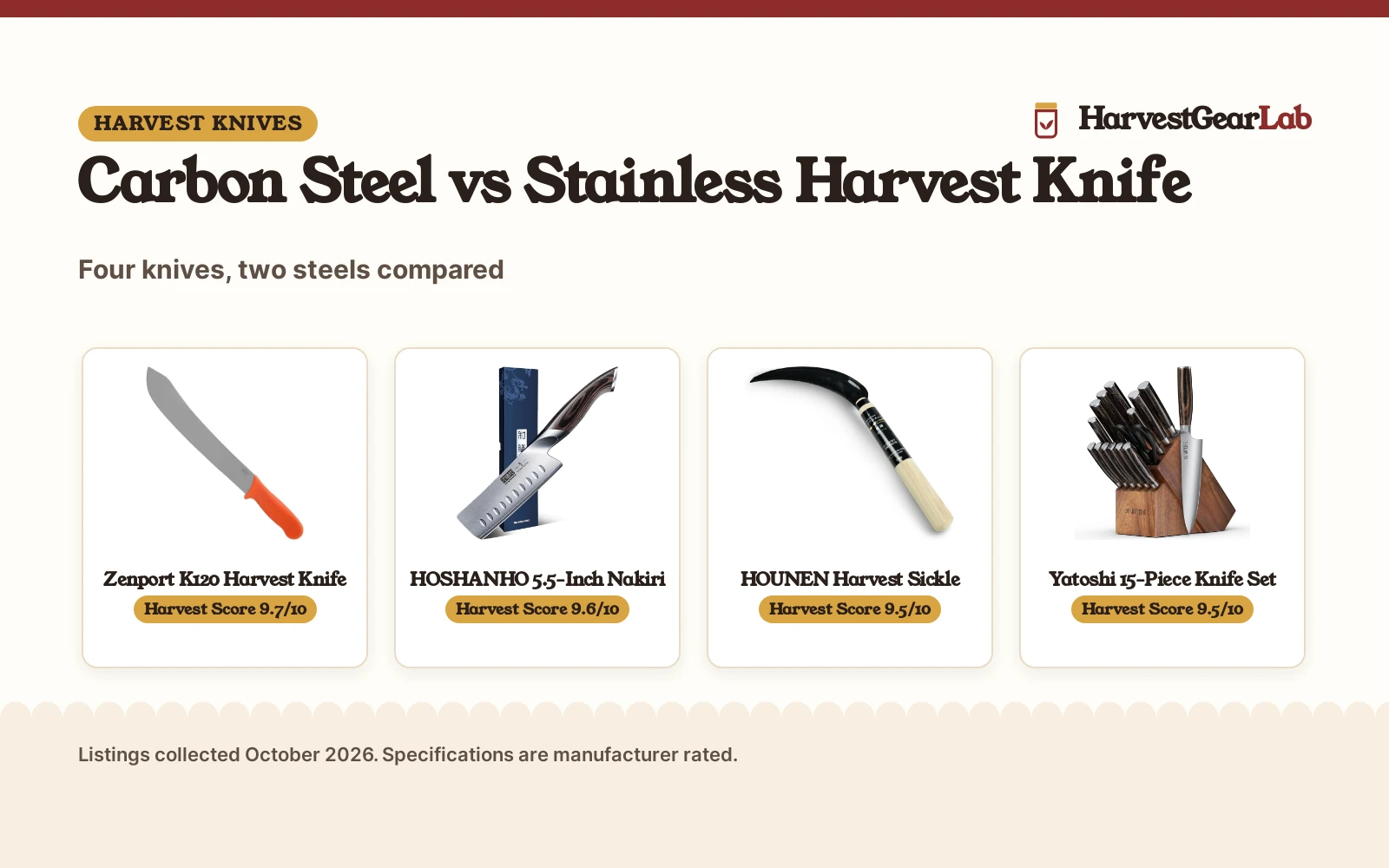
A crate of tomatoes on the counter and herbs waiting in the rows: the carbon steel vs stainless steel harvest knife question comes up when you decide what you will cut with all season. Carbon steel takes a keener edge for precise cuts, while stainless steel shrugs off wet field work and washes clean. We compared two listings per side, looking strictly at what each listing publishes: on the carbon steel side, the HOSHANHO 5.5-inch nakiri and the Yatoshi 15-piece knife set; on the stainless steel side, the HOUNEN 5.9-inch harvest sickle and the Zenport K120 12-inch field knife.
HarvestGearLab earns a commission when you buy through links on this page, at no extra cost to you. As an Amazon Associate I earn from qualifying purchases. Affiliate disclosure.
Quick verdict: choose carbon steel if you want the keenest stated edge: the HOSHANHO example lists 60HRC hardness and a 15-degree edge angle. Choose stainless steel for wet field work: the Zenport K120 example pairs a 12-inch stainless steel blade with a textured non-slip handle, and the HOUNEN sickle weighs just 3.52 ounces for row work.
Four examples
| # | Product | Harvest Score | Buy |
|---|---|---|---|
| 1 | Zenport K120 Harvest Knife | 9.7/10 | Buy on Amazon |
| 2 | HOSHANHO 5.5-Inch Nakiri | 9.6/10 | Buy on Amazon |
| 3 | HOUNEN Harvest Sickle | 9.5/10 | Buy on Amazon |
| 4 | Yatoshi 15-Piece Knife Set | 9.5/10 | Buy on Amazon |

Zenport K120 Harvest Knife
A field harvest knife with a 12-inch stainless steel blade, 17 inches overall, and a textured non-slip plastic handle.
Pros
- 12-inch stainless steel blade
- Textured non-slip plastic handle
- 9.28 ounces, light for its length
- Straight edge, easy to clean and sanitize
Cons
- Stamped construction, not forged
- No sheath or storage is stated
- No warranty term is stated
- 12-inch blade is long for tight rows

HOSHANHO 5.5-Inch Nakiri
A 5.5-inch nakiri with 10Cr15CoMoV high carbon stainless steel at 60HRC, a 15-degree edge and a pakkawood handle.
Pros
- 60HRC hardness after vacuum heat treatment
- 15-degree edge angle
- Ergonomic pakkawood handle
- Forged construction
Cons
- Kitchen knife, not a field harvest tool
- No weight is stated
- No warranty term is stated
- Plain edge needs regular honing

HOUNEN Harvest Sickle
A 5.9-inch serrated harvest sickle in SK-5 steel, 3.52 ounces, made in Japan, for pull-cutting stalks and herbs.
Pros
- Serrated saw teeth grip slippery stalks
- 3.52 ounces, the lowest stated weight here
- Made in Japan
- 13.7 inches overall with wood handle
Cons
- Not intended for chopping or heavy branches
- No warranty term is stated
- Serrated edge is harder to sharpen
- 5.9-inch blade, short for tall crops
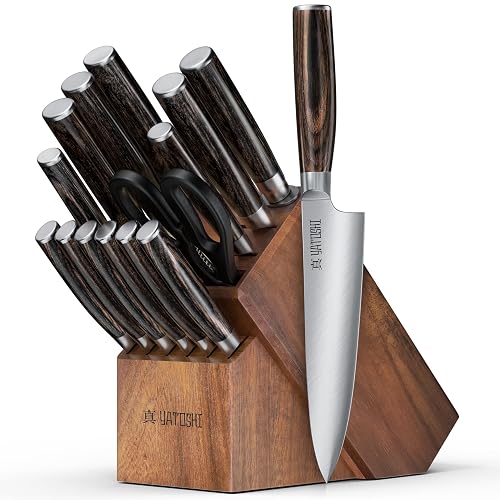
Yatoshi 15-Piece Knife Set
A 15-piece knife set in 7Cr17 high-carbon steel at 57-58 Rockwell, with an acacia wood block, weighing 10 pounds.
Pros
- 15 pieces including honing steel and scissors
- 0.6-0.75% carbon content stated
- 57-58 Rockwell hardness
- Acacia wood block included
Cons
- Kitchen set, not field harvest tools
- 10 pounds, the heaviest here
- No warranty term is stated
- Block takes counter space
As an Amazon Associate I earn from qualifying purchases.
Carbon steel vs stainless steel harvest knife: side by side
| Knife | Harvest Score | Side | Blade | Steel | Handle | Weight | Amazon |
|---|---|---|---|---|---|---|---|
| Zenport K120 Harvest Knife | 9.7/10 | Stainless steel | 12 inches | Stainless steel | Textured plastic | 9.28 ounces | View on Amazon |
| HOSHANHO 5.5-Inch Nakiri | 9.6/10 | Carbon steel | 5.5 inches | 10Cr15CoMoV, 60HRC | Pakkawood | Not stated | View on Amazon |
| HOUNEN Harvest Sickle | 9.5/10 | Stainless steel | 5.9 inches, serrated | SK-5 steel | Wood | 3.52 ounces | View on Amazon |
| Yatoshi 15-Piece Knife Set | 9.5/10 | Carbon steel | 3.5 to 8 inches | 7Cr17, 57-58 HRC | Wood | 10 pounds | View on Amazon |
We list the manufacturer’s stated figures without changes, as of 18 October 2026.
Blade steel and hardness
The carbon steel side states its metallurgy. The HOSHANHO nakiri lists 10Cr15CoMoV high carbon stainless steel at 60HRC after vacuum heat treatment, with a 15-degree edge angle. The Yatoshi set lists 7Cr17 high-carbon steel with 0.6-0.75% carbon content and 57-58 Rockwell hardness. The stainless steel side states no hardness figures: the Zenport K120 lists only stainless steel, and the HOUNEN lists SK-5 steel while its spec table says high carbon steel. With hardness stated on one side only, neither side wins on hardness from these listings.
Blade length and weight
Length and weight split by job. The Zenport K120 has a 12-inch blade, 17 inches overall, at 9.28 ounces. The HOUNEN sickle has a 5.9-inch serrated blade, 13.7 by 3 by 0.7 inches overall, at 3.52 ounces. The HOSHANHO nakiri has a 5.5-inch blade but states no weight. The Yatoshi set is a different animal: 15 pieces in an acacia wood block weighing 10 pounds, which is storage, not a field tool.
Handles and intended use
Handles run pakkawood on the HOSHANHO, wood on the Yatoshi knives and the HOUNEN sickle, and textured non-slip plastic on the Zenport K120. Use splits cleanly by side: the carbon steel examples are kitchen knives for vegetables, meat and fruit, while the stainless steel examples are field tools, the HOUNEN for pull-cutting lavender, herbs and rice stems and the Zenport for cutting field crops. For more field picks, see our best harvest knife for vegetables.
Listing gaps to check
None of the four listings states a warranty term. The HOSHANHO states no weight. The HOUNEN spec table says high carbon steel even though the listing is tagged to the stainless steel side, so confirm the steel with the seller if it matters to you. The Yatoshi 15-piece count includes a honing steel, scissors and the block, not 15 knives.
Which should you choose?
Choose carbon steel if you want the keenest stated edge for precise cutting and you will maintain the blade: the HOSHANHO example states 60HRC and a 15-degree edge, and the Yatoshi set adds 0.6-0.75% carbon content at 57-58 Rockwell across 15 pieces.
Choose stainless steel if you cut in the field and want easy cleaning: the Zenport K120 example pairs a 12-inch stainless blade with a textured non-slip handle, and the HOUNEN sickle at 3.52 ounces suits pull-cutting herbs and stalks. Compare more edge shapes in our serrated vs smooth harvest knife guide.
In the Preserving Kitchen
- Clean and dry the HOUNEN teeth after each use and store the sickle dry, per the listing.
- Rinse the Zenport K120 after field work; the listing calls it easy to clean and sanitize.
- Keep the Yatoshi knives in the acacia block, whose deep slots the listing says safeguard the blades.
- Wipe the HOSHANHO blade clean between tasks; the pakkawood handle is shaped to reduce fatigue in long sessions.
How the Harvest Score played out
| Product | Harvest Score | Perf. /35 | Build /25 | Value /25 | Safety /10 | Warranty /5 |
|---|---|---|---|---|---|---|
| Zenport K120 Harvest Knife | 9.7 | 33 | 22 | 21 | 5 | 0 |
| HOSHANHO 5.5-Inch Nakiri | 9.6 | 32 | 21 | 20 | 4 | 0 |
| HOUNEN Harvest Sickle | 9.5 | 30 | 20 | 19 | 4 | 0 |
| Yatoshi 15-Piece Knife Set | 9.5 | 29 | 21 | 19 | 3 | 0 |
Shown scores begin at 9.2 and stop at 9.8. Where a pick lands depends only on its weighted total: more points, never a lower result.
The Harvest Score weighs performance, build, value, safety and warranty. For harvest knives, safety covers the stated features that keep cutting under control: the textured non-slip handle on the Zenport, the ergonomic pakkawood handle on the HOSHANHO and the ergonomic grip on the HOUNEN. The Zenport scores highest for its 12-inch stainless field blade and grip; the HOSHANHO follows for its stated 60HRC edge. None earns warranty points because none states a term.
FAQ: preserving at home
Which listing states the lowest weight?
The HOUNEN sickle at 3.52 ounces. The Zenport K120 is 9.28 ounces and the Yatoshi set is 10 pounds; the HOSHANHO states no weight.
Which blades are serrated?
Only the HOUNEN, whose saw teeth hold slippery stalks for pull-cutting. The other three list plain or straight edges.
Which listings state a warranty term?
None of the four states a warranty term.
Is the HOUNEN really stainless steel?
It is tagged to the stainless steel side here, but its spec table says high carbon steel and the title names SK-5 steel. Confirm with the seller if the steel matters to you.
More preserving guides
See every harvest knives guide and all harvest and processing guides.
More picks: harvest knives for vegetables, serrated vs smooth and folding vs fixed blade.