
On this page
Top picks at a glance
As an Amazon Associate I earn from qualifying purchases.
- 1
 Rimigood Ceramic Herb Stripper Bowl9.5/10View on Amazon
- 2
 Moss & Stone Kitchen Cutlery White Ceramic Knife SetView on Amazon
- 3
 Portable Ceramic Paring Knife Paring Knives Set of 3 FruitView on Amazon
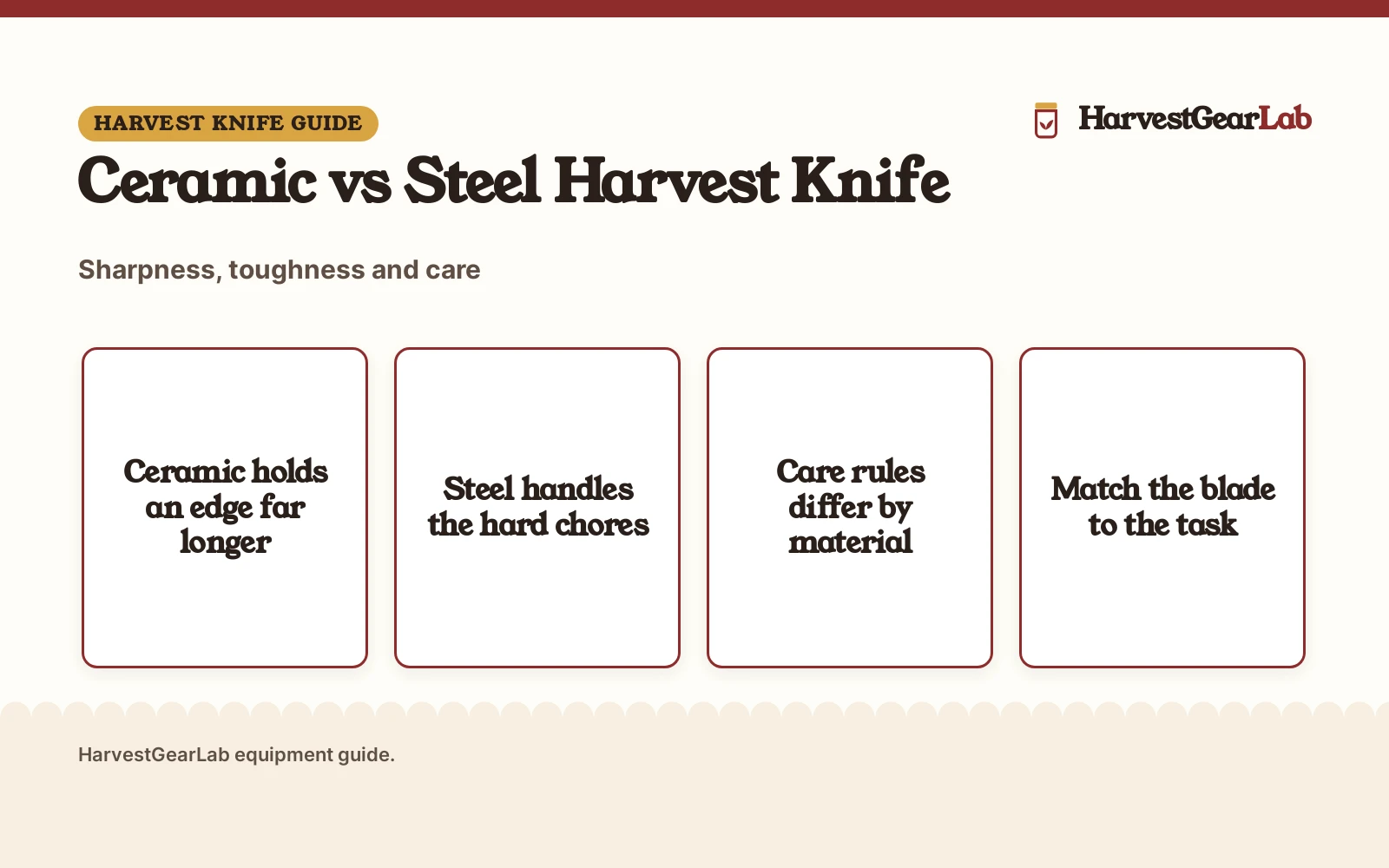
Ceramic vs steel harvest knife comes down to what you cut most. Ceramic blades, usually zirconium oxide, hold an edge far longer than steel: Kyocera states its ceramic stays sharp up to 10x longer than traditional steel knives. Steel blades are tougher, shrug off hard chores like frozen food and bone, and can be resharpened when they dull. Pick ceramic for slicing produce and herbs; pick steel for heavy field work.
Runners-up to consider
 Moss & Stone Kitchen Cutlery White Ceramic Knife SetCheck price on Amazon
 Portable Ceramic Paring Knife Paring Knives Set of 3 FruitCheck price on Amazon
HarvestGearLab earns a commission when you buy through links on this site, at no extra cost to you. As an Amazon Associate I earn from qualifying purchases. Affiliate disclosure.
Ceramic vs steel harvest knife: the short list
- Sharpness: ceramic holds its edge far longer; Kyocera claims up to 10x longer than steel.
- Toughness: steel wins; ceramic is not rated for frozen food, bone or hard-skinned squash.
- Reactivity: ceramic is non-reactive, so cut fruit does not brown as fast and picks up no metallic taste.
- Maintenance: steel can be resharpened at home; ceramic needs diamond tooling or factory service.
Where ceramic wins
Ceramic blades are ground from zirconium oxide, a material far harder than steel, which is why the edge lasts. Listings describe the blades as rust-proof and non-absorbent, so they will not stain, will not transfer odors between foods, and will not react with acidic fruit or vegetable juices. For harvest work that means sliced tomatoes, peppers and berries keep their flavor and color longer. Ceramic knives also run light: the Vos paring knife weighs 0.07 kg, and sets like the Vos 4, 5 and 6 inch trio ship with protective sheaths for safe storage. Kyocera pairs its 3 inch paring knife with a 5-year limited warranty, and Moss and Stone covers its 6 inch ceramic set for 1 year.
Where steel wins
Steel is the tougher material, and toughness matters in the field. Farberware’s ceramic care notes read like a list of things steel handles easily: ceramic blades are not intended for frozen foods, hard-skinned fruits and vegetables such as watermelon or spaghetti squash, hard cheeses, or meat and poultry with bone. A stainless blade such as the SENBON 440A folding knife, with its 4.8 inch forged blade and 180 g weight, takes that kind of work in stride. Steel also gives you construction choices: forged blades like the SENBON and the Hancorys 13 piece set, or stamped blades like the CAROTE floral 12 piece set. And when a steel edge dulls, a basic sharpener brings it back; ceramic cannot be maintained the same way.
Care rules that differ
Ceramic demands a gentler routine. Use only a plastic or wood cutting board, per the Farberware care notes, and hand washing is recommended to extend the life of the edge even where top-rack dishwasher safety is stated. Steel is more forgiving: several stainless listings state dishwasher safety outright, and the CAROTE 12 piece set pairs stainless blades with a ceramic nonstick coating for easy cleaning. Both materials benefit from blade guards or sheaths in a crowded drawer; the Vos, CAROTE and Hancorys listings all include them.
Which one for harvest work
Match the blade to the chore. For slicing harvested produce at the table, trimming herbs and prepping vegetables, ceramic’s long-lasting edge and non-reactive surface are genuine advantages. For field chores, woody stems, hard squash and anything frozen, steel is the safer pick. Many growers end up with both: a ceramic paring or santoku knife for the kitchen and a stainless field knife for the garden. Our best harvest knife for vegetables and best harvest knife for fruit guides line up specific listings.
Blade sizes in the listings
Ceramic listings cluster around small and mid-size blades: a 3 inch Kyocera paring knife, a 5 inch Farberware santoku, a 6 inch Moss and Stone set blade, and the Vos trio at 4, 5 and 6 inches. Steel listings run larger: 8 inch chef knives anchor the CAROTE 12 piece, Hancorys 13 piece and CAROTE floral 12 piece sets, alongside 7 inch santoku, 5 inch utility and 3.5 inch paring blades. The SENBON folding knife splits the difference with a 4.8 inch blade in a 10.2 inch open length that folds to 5.4 inches. Weight follows size: the Vos ceramic paring knife is 0.07 kg and the SENBON folder is 180 g, while full steel sets weigh 0.75 to 0.79 kg, or 1.9 pounds for the floral CAROTE set.
Value signals beyond the blade
Since listings rarely state prices, read the warranty and the included extras. Kyocera states a 5-year limited warranty on its 3 inch paring knife, the longest here, while Moss and Stone covers its ceramic set for 1 year. Protective sheaths or blade guards appear across both materials: the Vos ceramic knives, the CAROTE sets and the Hancorys set all include them, which matters because a ceramic edge chips more easily in a crowded drawer. Dishwasher notes also differ: the Farberware ceramic is top-rack safe with hand washing recommended, while several stainless sets state dishwasher safety outright.
FAQ: preserving at home
Can a ceramic knife go in the dishwasher?
The Farberware ceramic santoku is top-rack dishwasher safe, but its care notes recommend hand washing to extend the life of the cutlery. Dry it immediately either way.
Will a ceramic knife chip on hard vegetables?
It can. Ceramic blades are not intended for frozen foods, hard-skinned fruits and vegetables such as watermelon or spaghetti squash, hard cheeses, or meat and poultry with bone.
How long does a ceramic edge last?
Kyocera states its ceramic stays sharp up to 10x longer than traditional steel knives, and the Vos set states its blades will not require sharpening for years.
More preserving guides
See every harvest and processing guide.
More picks: carbon steel vs stainless steel harvest knife, garden knives for harvesting, serrated vs smooth harvest knife and harvest knives for vegetables.