
On this page
Top picks at a glance
As an Amazon Associate I earn from qualifying purchases.
- 1
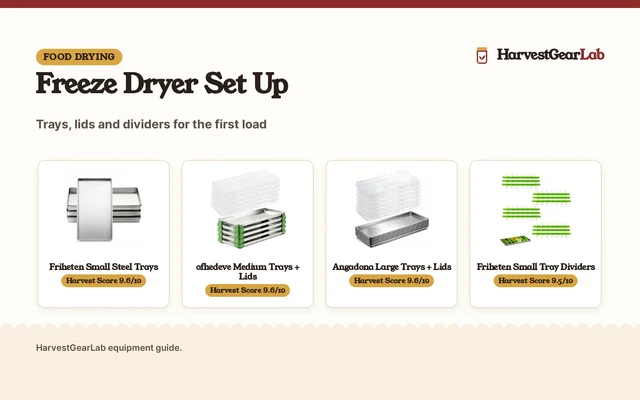
 Friheten 4 Sets Small Stainless Steel Trays for Harvest Right9.6/10View on Amazon
- 2
 Angadona 6 Sets Large Metal Trays with Lids for Harvest Right9.6/10View on Amazon
- 3
 Friheten 4 Sets Freeze Dryer Tray Dividers for Harvest Right9.5/10View on Amazon
When the harvest comes in faster than the pantry can hold it, a freeze dryer starts to look like the way to keep it. Freeze dryer price is the first question most buyers ask, and the answer depends on batch size, trays, presets and the space the machine needs. This guide walks through what sets the cost, what to compare across listings, and what to check before you buy.
HarvestGearLab earns a commission when you buy through links on this site, at no extra cost to you. As an Amazon Associate I earn from qualifying purchases. Affiliate disclosure.
Freeze dryer price: the short list
These cost drivers shape what a home freeze dryer sells for. The table shows each one and what the listings state.
| Cost driver | What it means | What the listings show |
|---|---|---|
| Batch size | How much food each run holds | 4.4 to 6.6 lbs, or 11 to 15.4 lbs per batch |
| Trays | How the batch spreads out | 4 trays on both VEVOR models |
| Presets | One-touch recipes for food types | 5 presets, or 10 presets |
| Power and cooling | Compressor, pump and cold trap | 1400W, cooling to -35°C or -60°C |
| Size and weight | Where it sits and how it moves | 27.6 by 14.8 by 23.6 in at 147.27 pounds, or 28.4 by 17.7 by 31.1 in at 217.16 pounds |
Batch size sets the scale
The batch size is the figure that shapes the cost more than any other. The VEVOR countertop model lists 4.4 to 6.6 lbs per batch, while the VEVOR freestanding model lists 11 to 15.4 lbs per batch. Both list 4 trays, so the difference sits in tray size and chamber size, not tray count. Match the batch size to the harvest you actually put up: a small garden suits the smaller batch, while a large harvest suits the larger one, and a machine that runs with trays left empty wastes power and time. See small vs medium freeze dryer and commercial vs home freeze dryer for how size classes compare.
Watch the units when you compare. The VEVOR listings state batch size in lbs and in kg, with 5 to 7 kg beside 11 to 15.4 lbs and 2 to 3 kg beside 4.4 to 6.6 lbs. Compare lbs to lbs and kg to kg, and check whether the listing states a batch size at all: some listings in this category state tray counts and temperatures but no batch weight, and a listing without a batch figure leaves you guessing how much food each run holds.
Trays, presets and controls
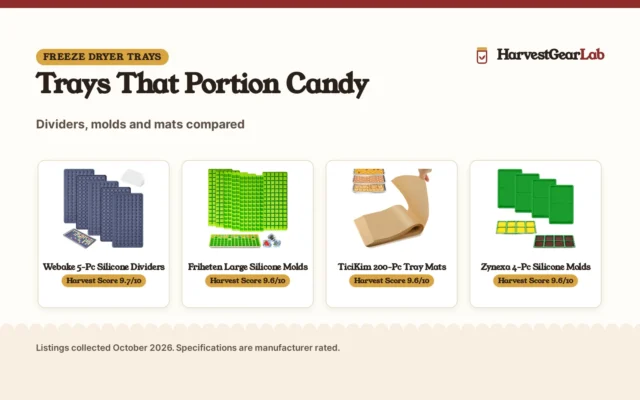
Trays decide how the batch spreads out. Both VEVOR freeze dryers list 4 trays, so the batch size difference comes from tray size and chamber size rather than tray count. Presets decide how much the machine does for you: the smaller VEVOR lists 5 preset recipes, while the larger one lists 10, with an LCD touchscreen and app control on the larger model. More presets suit a buyer who dries many food types, while a buyer who dries the same foods each season may not need them. See best freeze dryer trays for how tray options compare.
Controls matter for daily use. The VEVOR models list a touchscreen and auto defrost, and the larger one lists app control and wheels for moving a 217.16 pound machine. Check the control list beside the batch size, since a simple machine with the right batch size often serves better than a loaded one with the wrong size.
Power, cooling and the parts that do the work
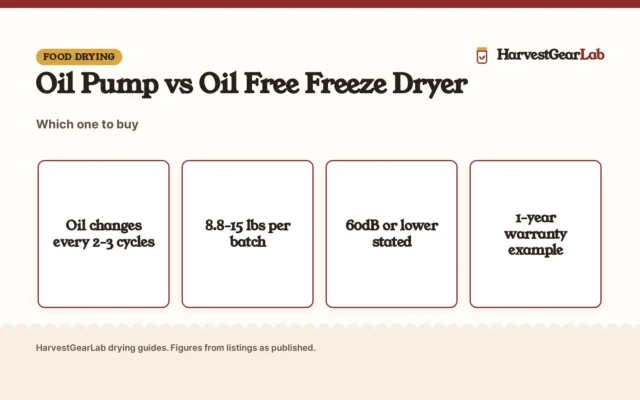
A true freeze dryer freezes the food hard, then pulls the water out under vacuum. The VEVOR listings state a compressor, a vacuum pump and a cold trap system, with cooling to -60°C on the larger model and to -35°C on the smaller one. The smaller model lists an integrated 1400W design, while the larger one lists a powerful compressor without a watt figure in the listing. Power and cooling set the running cost and the drying speed, so compare the pump and cold trap beside the batch size.
Size and weight shape where the machine lives. The smaller VEVOR measures 27.6 by 14.8 by 23.6 in and weighs 147.27 pounds, while the larger one measures 28.4 by 17.7 by 31.1 in and weighs 217.16 pounds. The smaller one fits on a countertop, while the larger one stands on the floor with wheels. Measure the space before you buy, and check the door and the path the machine travels, since a machine that does not fit the room cannot do its job.
Check that it is a freeze dryer
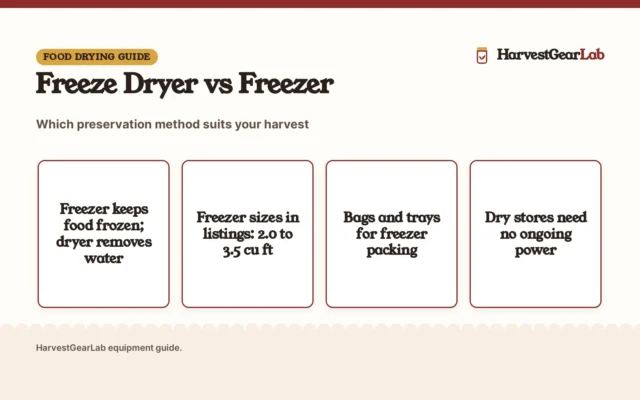
Not every listing titled as a freeze dryer is one. The JLFTHYLL listings list 10 or 12 layers of 304 stainless steel trays, each holding up to 1.7 lbs of food, yet their bullets describe hot air circulation and temperatures from 86 to 194°F, which is how a dehydrator dries, not how a freeze dryer works. The Ayovoch listing is a dehydrator too, with 18 trays, 800W dual fans and a 24-hour timer, and the QUGURLID listings describe a rear-mounted fan with hot air circulation. A true freeze dryer lists a compressor, a vacuum pump and a cold trap, like the VEVOR models do. Before you compare prices, check the listing for those parts, since a dehydrator and a freeze dryer are different machines at different prices. See freeze dryer vs freezer and freeze dryer vs dehydrator for how the machines differ.
What to skip or double-check
- A listing without a batch weight: if it states trays and temperatures but no lbs per batch, you cannot compare its size.
- A dehydrator titled as a freeze dryer: check for a compressor, a vacuum pump and a cold trap before you compare prices.
- Presets you will not use: 10 presets suit many food types, while 5 suit a narrower routine.
- A machine that does not fit the space: measure the spot and the path in before you buy.
- No weight stated: moving a machine of this size takes planning, so check the weight before you buy.
What this guide does not cover
This is a price guide. It does not state a price for any machine, since prices change and listings change with them, and it does not give drying times or recipes. For drying guidance, follow current USDA and National Center for Home Food Preservation guidance, and for a fault or a leak, contact the maker or a licensed technician. Every food drying guide on the site is collected in the food drying section.
FAQ: preserving at home
Why do freeze dryer prices vary so much?
Batch size, trays, presets, power and size all move the cost, and a true vacuum freeze dryer costs more than a hot-air dehydrator sold under a similar name. Compare the batch weight, the tray count and the pump and cold trap before you compare prices.
What batch size do I need?
Match it to the harvest you put up. The VEVOR countertop model lists 4.4 to 6.6 lbs per batch, while the freestanding model lists 11 to 15.4 lbs per batch, so weigh a typical batch before you choose.
Is a freeze dryer the same as a dehydrator?
No. A freeze dryer freezes food, then pulls water out under vacuum with a compressor, a vacuum pump and a cold trap. A dehydrator dries with hot air, such as the 86 to 194°F range the JLFTHYLL listings state.
Do I need 10 presets?
Not always. The smaller VEVOR lists 5 presets and the larger one lists 10, so pick the count that matches the food types you dry. A buyer who dries the same foods each season may not need the longer list.
What size space does a freeze dryer need?
Check the listing. The smaller VEVOR measures 27.6 by 14.8 by 23.6 in and weighs 147.27 pounds, while the larger one measures 28.4 by 17.7 by 31.1 in and weighs 217.16 pounds. Measure the spot and the path in before you buy.
More preserving guides
See every food drying guide and all freeze dryers guides.
More picks: freeze dryer vs freezer, freeze dryer trays, freeze drying for beginners and freeze dryer setup.