
On this page
Top picks at a glance
As an Amazon Associate I earn from qualifying purchases.
- 1
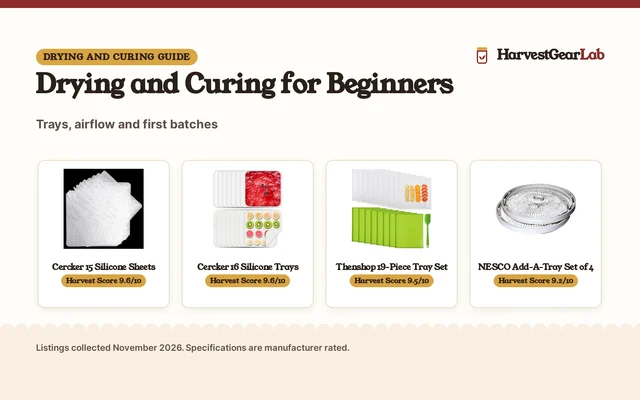
 Cercker 15 Pack Silicone Dehydrator Sheets9.6/10View on Amazon
- 2
 Cercker 8 Silicone Dehydrator Trays with Edge and 8 Mesh Mats9.6/10View on Amazon
- 3
 Thenshop 8 Silicone Dehydrator Trays9.5/10View on Amazon
Freeze drying for beginners starts with a plain fact: a freeze dryer freezes food solid, then pulls the water out under vacuum, so the food keeps its shape and keeps well in storage. It is not the same as a dehydrator, which dries food with warm air, and the machines do not swap jobs. This guide walks through how freeze drying works, what a home machine looks like, and what to check before you buy one.
HarvestGearLab earns a commission when you buy through links on this site, at no extra cost to you. As an Amazon Associate I earn from qualifying purchases. Affiliate disclosure.
Freeze drying for beginners: the short list
Freeze drying runs in 3 steps, and each step needs the machine to do one job well. The table shows the steps in order.
| Step | What happens | What the machine does |
|---|---|---|
| Freeze | The food freezes solid on the trays | The compressor cools the chamber |
| Vacuum | Air leaves the chamber and pressure drops | The vacuum pump pulls the air out |
| Dry | Ice leaves the food as vapor | The cold trap catches the vapor |
How freeze drying works
Freeze drying works by freezing the water inside food, then letting that ice turn straight into vapor without melting. The chamber stays cold while the food freezes, then the vacuum pump pulls the air out and the pressure drops. With the pressure low, the ice leaves the food as vapor and collects in the cold trap, and the food comes out dry while keeping its shape.
That is the whole trick, and it is why a freeze dryer is built around a compressor, a vacuum pump and a cold trap rather than a heater and a fan. The VEVOR machines in the listings here cool to -60°C on the larger model and -35°C on the countertop model, which shows the range of cold a home machine is built to hold.
Freeze dryer or dehydrator: do not mix them up
Many listings carry the words freeze dryer in the title and then describe a dehydrator. The giveaway is the heating: if the listing talks about hot air, a rear fan and a temperature range, it is a dehydrator. The listings here show dehydrators with a temperature range of 86 to 194°F, a 24-hour timer and up to 18 trays, all built around warm air.
A real freeze dryer talks about cold and vacuum instead: a compressor, a vacuum pump, a cold trap and a chamber door that seals tight. The VEVOR freeze dryers in the listings here list a vacuum pump and a cold trap, with cooling to -60°C or -35°C, and no heating range at all. When you compare listings, check for the vacuum pump first: if there is no pump and no cold trap, the machine dries with warm air. The freeze dryer vs dehydrator comparison walks through the difference in full.
What a home freeze dryer looks like
Home freeze dryers come in 2 sizes in the listings here. The countertop VEVOR model measures 27.6 x 14.8 x 23.6 inches, weighs 147.27 pounds, holds 4 trays and processes 4.4 to 6.6 lbs per batch, with 5 presets and a 1400W design. It fits on a kitchen counter, but it is heavy, so the counter needs to be solid and the machine needs to stay put once it is set down.
The freestanding VEVOR model measures 28.4 x 17.7 x 31.1 inches, weighs 217.16 pounds, holds 4 trays and processes 11 to 15.4 lbs per batch, with 10 presets, app control and wheels. The larger batch suits a big harvest, and the wheels help move a machine that heavy.
Both models share the same shape of controls: a touchscreen, preset recipes and auto defrost. The countertop model lists 5 presets for fruit, vegetables, meat, liquids and candy, while the freestanding model lists 10 presets. Pick the batch size first, then check the size and weight against the spot where the machine will live.
What to check before you buy
- Batch size: match the pounds per batch to the harvest you dry in one run: 4.4 to 6.6 lbs on the countertop model, 11 to 15.4 lbs on the freestanding model.
- Trays: both VEVOR models hold 4 trays, so a bigger batch means more food on each tray, not more trays.
- Presets: a preset sets the cycle for a food type, so check that the foods you dry most have a preset: the countertop model lists fruit, vegetables, meat, liquids and candy.
- Size and weight: measure the counter or floor space and check the weight: 147.27 pounds for the countertop model and 217.16 pounds for the freestanding model.
- Vacuum pump and cold trap: a freeze dryer needs both, so check that the listing names them.
- Defrost: both models list auto defrost, which clears the ice from the chamber between batches.
What this guide does not cover
This is an equipment guide. It does not give recipes, drying times, or storage times. Take those from current USDA and National Center for Home Food Preservation guidance, or from a current edition of a trusted preserving guide, and follow them exactly for each food. Every food drying guide on the site is collected in the food drying section.
FAQ: preserving at home
Is a freeze dryer the same as a dehydrator?
No. A freeze dryer freezes food solid and pulls the water out under vacuum, while a dehydrator dries food with warm air. The dehydrators in the listings here work across 86 to 194°F, while the VEVOR freeze dryers cool to -60°C or -35°C and use a vacuum pump and a cold trap.
How much food fits in one batch?
It depends on the model. The countertop VEVOR model processes 4.4 to 6.6 lbs per batch, and the freestanding VEVOR model processes 11 to 15.4 lbs per batch. Both models hold 4 trays, so the batch size is the figure to compare.
Where do I put a home freeze dryer?
Measure the spot first. The countertop model measures 27.6 x 14.8 x 23.6 inches and weighs 147.27 pounds, so it needs a solid counter. The freestanding model measures 28.4 x 17.7 x 31.1 inches, weighs 217.16 pounds and has wheels, so it suits a floor spot in a pantry or utility room.
What do the presets do?
A preset sets the cycle for one food type, so you pick the food and the machine runs the right cycle for it. The countertop model lists 5 presets for fruit, vegetables, meat, liquids and candy, and the freestanding model lists 10 presets.
More preserving guides
See every freeze dryers guide and all food drying guides.
More picks: freeze dryer vs dehydrator, commercial vs home freeze dryer, freeze dryer trays and mylar bags for freeze-dried food.