
On this page
When the counter is covered with sliced tomatoes and fresh apples are coming off the tree, horizontal flow vs vertical flow dehydrator is the question that decides how evenly those trays dry. The short answer: horizontal flow uses a rear fan to push heated air across every tray at the same time, while vertical flow uses a fan at the bottom or top to move air up or down through stacked trays. This guide explains each design step by step, using only what current listings state about their specs.
HarvestGearLab earns a commission when you buy through links on this site, at no extra cost to you. As an Amazon Associate I earn from qualifying purchases. Affiliate disclosure.
Horizontal flow vs vertical flow dehydrator: the airflow in plain terms
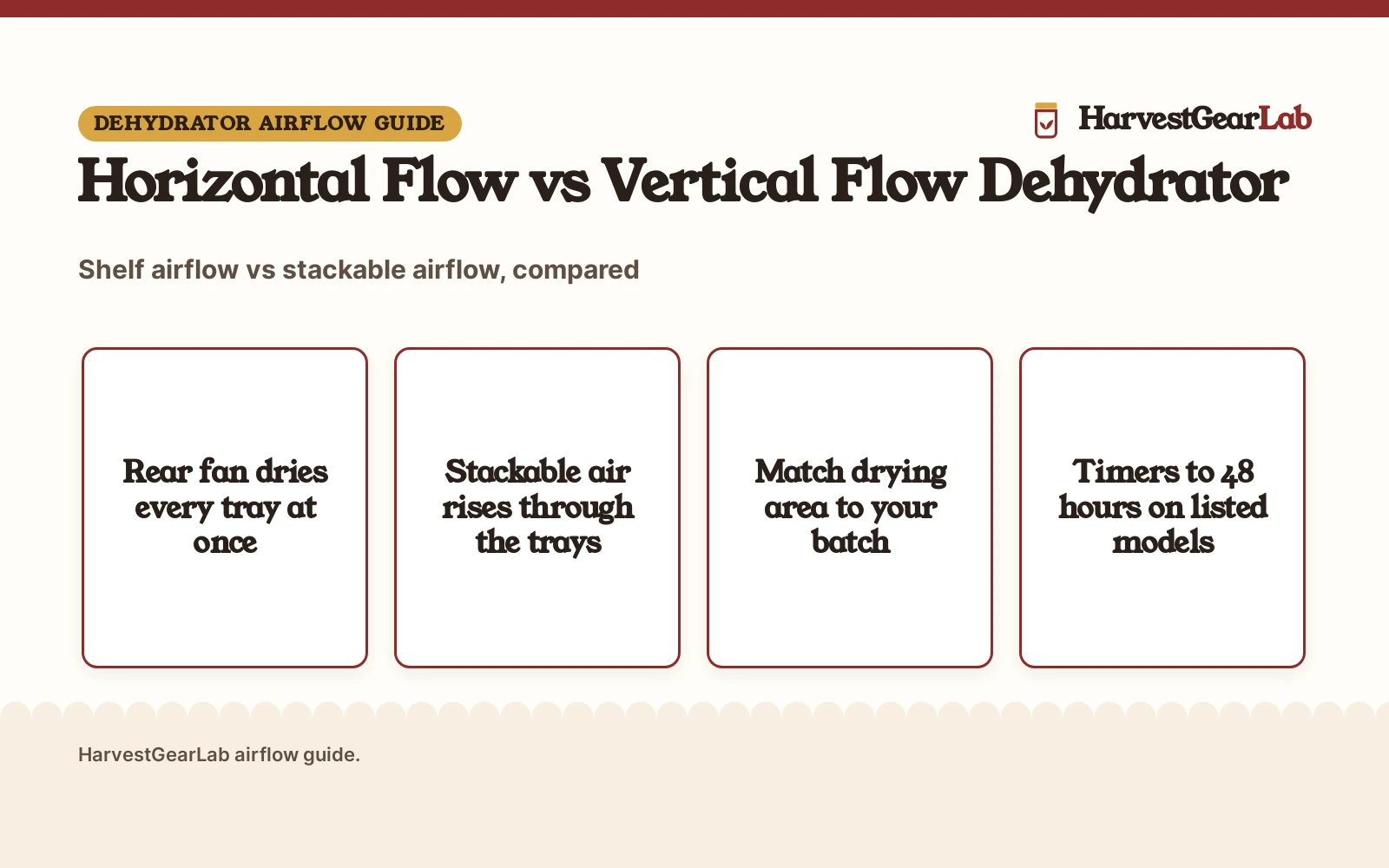
The difference is the path the heated air takes. In a horizontal flow dehydrator, the fan and heater sit in the back wall, and air moves sideways across shelf-like trays that slide in from the front, so the top tray and the bottom tray meet the same air. In a vertical flow dehydrator, trays stack on top of each other, and air rises from a fan at the base (or drops from the top) through each layer in turn. That path is why the two designs behave differently when you fill every tray.
| Design | Where the fan sits | How the air moves | Tray rotation |
|---|---|---|---|
| Horizontal flow (shelf style) | Back wall | Across every tray at the same time | The listings state none is needed |
| Vertical flow (stackable style) | Base or top of the stack | Up or down through stacked trays | Traditional stackable designs call for it |
How horizontal flow dries the harvest
Horizontal flow models are shelf machines: you slide trays in like a small oven, and the rear fan bathes each tray in the same heated air. The Cosori CP267-FD lists 6 stainless steel trays with 6.5 ft² of drying space, a 95 to 165°F range, 600W of heating power, a 48H timer, and operation under 48 dB, with automatic shutoff and overheat protection, ETL listed, and a 2 year manufacturer warranty; the listing states drying happens without rotating trays. The larger Cosori CFD-P103 lists 10 trays and 7.4 ft², a 95 to 167°F range, 640W, 48 dB, a 48H timer, and room for 5.5 lbs of beef sliced to 5 mm, with a 46-recipe cookbook and dishwasher-safe trays. The Empculd EMHD005-5 lists a horizontal airflow system with 5 stainless steel trays, 3.1 ft² of drying area, an 86 to 194°F knob-controlled range, 400W, a timer of up to 12 hours, and noise under 50 dB, with 1.2-inch tray spacing for thicker cuts and a body measuring 11.8 by 11.4 by 8.3 inches at 8.1 pounds.
Because the air reaches every tray at the same time, this design suits big mixed batches: fruit on one tray, jerky on another, herbs on a third, with no need to swap tray positions mid-batch. If you dry enough to fill the 10-tray models, look at the total drying area the listing states rather than the tray count alone, since tray size varies between makers.
The Elite Gourmet EFD1035 lists an advanced rear fan with 360° airflow across 10 stainless trays, a 95 to 167°F range with presets, and a 48-hour timer, and states that no tray rotation is needed, unlike traditional stackable dehydrators. That maker comparison is a good reminder of what horizontal airflow gives you: every tray finishes at the same pace.
How vertical flow dries the harvest
Vertical flow machines are the round or rectangular stackables: trays pile up, and the fan at the bottom (sometimes the top) pushes heated air through the whole stack. The trays nearest the fan see the hottest air at the start, so the far trays dry more slowly, and makers of this style traditionally advise swapping tray positions during a batch. The Elite Gourmet listing notes that traditional stackable dehydrators call for tray rotation, which is exactly this effect.
The stackable shape has its own appeal. You can add or remove trays to match the batch, the footprint stays small on the counter, and the design is simple to clean. For herbs and small fruit loads that fit a short stack, the unevenness matters less than it does for a full load of jerky, where even drying across trays matters most.
The reference listings for this guide cover horizontal flow machines; no stackable listing is included, so compare any stackable model on the specs its own listing states: tray count, temperature range, timer, and whether the maker mentions tray rotation.
Horizontal flow vs vertical flow dehydrator: how to choose
Choose by batch size and patience. If you dry full loads in season, pick a horizontal flow shelf model with the drying area your harvest needs: the 10-tray listings state 7.4 ft² of space and room for 5.5 lbs of beef sliced to 5 mm, while the compact Empculd states 3.1 ft² with 5 trays. If counter space is tight and you mostly dry herbs or small fruit batches, a stackable vertical flow model with fewer trays keeps the footprint small, as long as you are willing to rotate trays.
Check the controls and the noise figure on the listing. Knob controls with an 86 to 194°F range suit simple setups, while digital presets with a 48H timer suit long overnight runs; the listings state under 48 dB to under 50 dB for quiet operation. For a deeper look at fan placement, see our rear fan vs bottom fan dehydrator comparison, and our stackable vs shelf food dehydrator guide lines up the two shapes side by side. The best food dehydrator roundup compares current listings by tray area.
FAQ: preserving at home
Do horizontal flow dehydrators need tray rotation?
The listings state no. Both the Cosori and Empculd horizontal airflow listings describe even drying without rotating trays, and the Elite Gourmet rear-fan listing states no tray rotation is needed.
Which airflow suits a full batch of jerky?
Horizontal flow suits full batches, since the rear fan moves heated air across every tray at the same time. The 10-tray listings state 7.4 ft² of drying space and room for 5.5 lbs of beef sliced to 5 mm.
What timer range do these dehydrators offer?
The Cosori listings state a 48H timer, the Elite Gourmet lists a 48-hour timer, and the Empculd lists up to 12 hours. The Cosori and Empculd listings also state automatic shutoff and overheat protection.
Are the trays dishwasher safe?
The Cosori listings state dishwasher-safe stainless steel trays, and the Empculd lists removable trays that can go directly in the dishwasher.
More preserving guides
See every food dehydrators guide and all food drying guides.
More picks: rear fan vs bottom fan dehydrators, stackable vs shelf food dehydrators, round vs rectangular food dehydrators and best food dehydrators.