
On this page
Top picks at a glance
As an Amazon Associate I earn from qualifying purchases.
- 1
 Etekcity Food Kitchen Scale9.6/10View on Amazon
- 2
 Amazon Basics Digital Kitchen Scale9.5/10View on Amazon
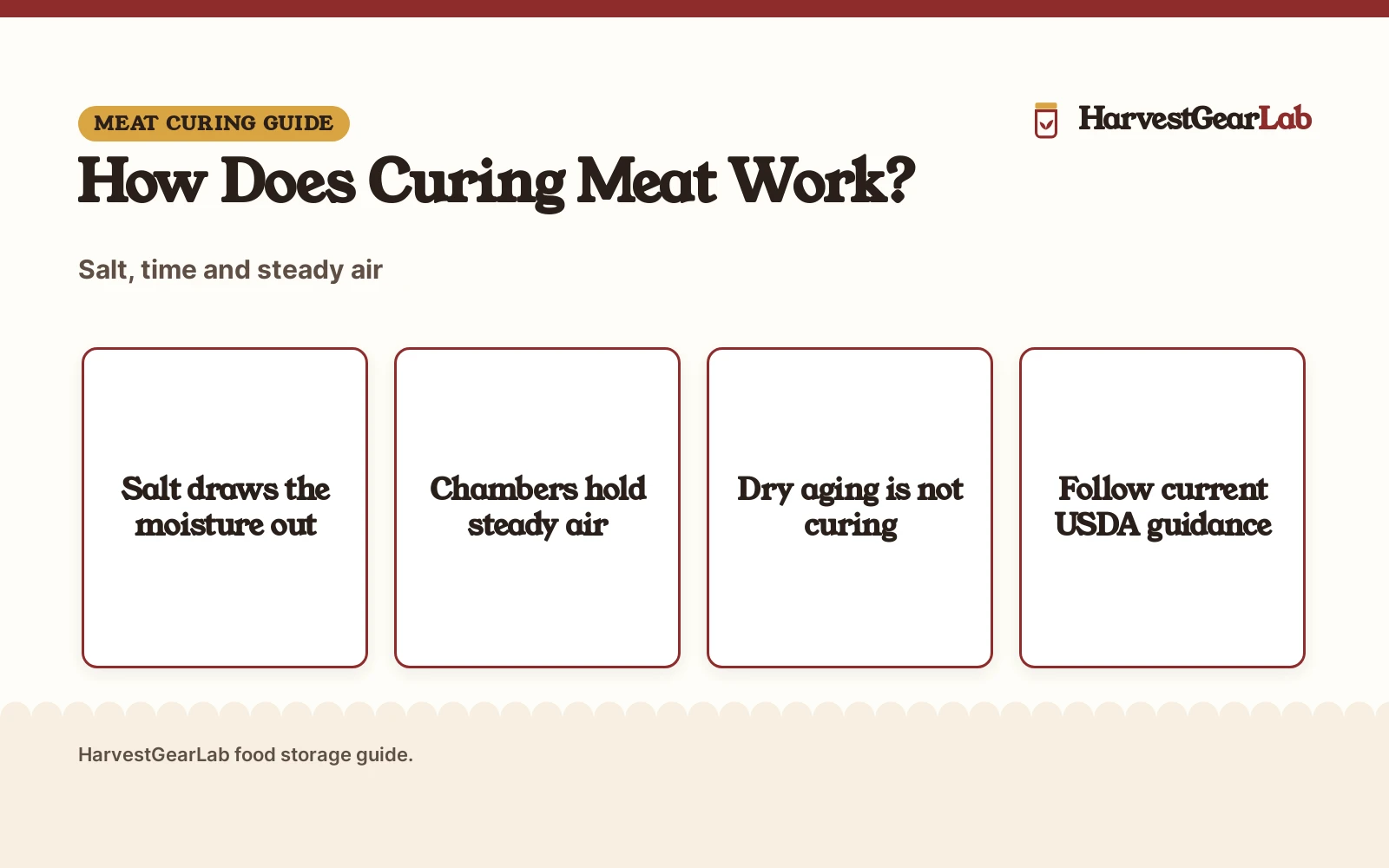
How does curing meat work is the question when a freezer needs filling and a side of meat is too much to eat fresh. The short answer: salt draws moisture out of the meat, nitrite slows harmful bacteria while it dries, and steady cool air lets it dry evenly. This guide walks through each part, then shows the chambers and tools that hold those conditions.
HarvestGearLab earns a commission when you buy through links on this site, at no extra cost to you. As an Amazon Associate I earn from qualifying purchases. Affiliate disclosure.
How does curing meat work: the short version
Salt, nitrite, air and time each do a job.
| Part | What it does | What it needs | Watch for |
|---|---|---|---|
| Salt | Draws moisture out of the meat and leaves less water for bacteria | Even cover over the whole cut | Bare spots stay wet |
| Nitrite | Slows harmful bacteria while the meat dries | Salt with nitrite, mixed as a current recipe states | Never guess the amount |
| Air | Carries moisture away from the surface so the cut dries through | Steady movement around the meat | Still air dries the outside first |
| Time | Flavor builds as moisture leaves | The cut dries through before it is ready | Cutting early leaves the center wet |
Start with salt, not with the chamber
Salt is the step that preserves: it pulls water out of the meat, leaving less water for bacteria. Salt alone does not finish the job: the meat still needs steady air to dry, and nitrite salt helps hold back harmful bacteria, including the bacteria that cause botulism, while it dries. Dry salt rubbed over the cut and brine soaking both work by the same idea, getting salt through the meat before drying starts. No chamber fixes a cut that was never salted.
Temperature and humidity: the chamber’s job
A chamber holds the air steady while the meat dries. The VEVOR dry aging fridges in the listings state a temperature range from 34°F to 77°F and humidity from 60% to 85%, while the Cobalance cabinets state 34°F to 72°F with humidity from 50% to 85% on the small unit and 36°F to 57°F with humidity from 50% to 85% on the large one. Warm air dries fast and unevenly, so the range matters more than any single setting. Follow a current USDA recipe for the setting your cut needs.
Do not confuse dry aging with salt preservation: dry aging keeps fresh beef cold while enzymes and drying change its flavor, and the VEVOR and Cobalance fridges are sold for that job. A salt-preserved cut is a different process, though it needs the same steady air. Our first harvest guide walks through the difference for a first batch.
Airflow and hanging
Air has to reach every side of the cut. The VEVOR fridges hang meat on hooks that hold up to 11 lbs each, with shelves that hold up to 66 lbs each, and the Ostreemaner cabinet hangs sausages and strips on 14 hooks. The Kalahari biltong box pairs 10 trays with 5 hanging rods and 36 hooks, and the Wmpusll cabinet (on Amazon) hangs batches on 12 hooks. Fans keep the air moving: the Kalahari lists an air speed of 1.8 m/s, and the large Cobalance lists 3.28 ft/s. When air stalls, the outside dries first and seals moisture inside.
Drying cabinets and dehydrators
Heat dryers work differently from cool chambers. The Kalahari biltong box runs from 20-90°C on 800 watts at 110 volts, with a timer from 30 minutes to 24 hours, and the Ostreemaner cabinet runs from 86°F to 194°F with a timer up to 24 hours. The Wmpusll cabinet runs from 86-176°F with a timer from 0.5-24 hours on 800 watts, and the aromaoveite cabinet (on Amazon) runs from 86-194°F with a 0-24 hour timer. These units dry jerky, biltong and sausages with warm air. See our how a food dehydrator works guide and the food dehydrator temperature guide before you pick a heat dryer.
Sealing and storing the finished meat
Once a cut is dry, keep air out. The MEAT! chamber vacuum sealer in the listings has a 12 inch sealing bar and a chamber that measures 21.9 x 19.4 x 19.0 inches, with sample packs in pint, quart and gallon sizes. Vacuum sealing keeps air out during fridge or freezer storage, but it does not make meat safe at room temperature, so follow current USDA guidance for how to store the finished cut. Our what is a chamber vacuum sealer guide explains the two sealer types.
What to skip or double-check
- Skipping the salt: drying meat without salt is not the same process, and a chamber cannot make up for salt left out.
- Guessing at nitrite salt amounts: follow a current USDA recipe and never estimate.
- A heat dryer for a cool chamber job: dehydrators run warm air from 86°F and up, while a salt-preserved cut needs cool, steady air.
- Copy-paste filler in a listing: one dry aging fridge listing talks about grass seed and compost; trust the temperature and humidity figures, not the filler.
- Listings that disagree with themselves: one cabinet lists 33 lbs in its title and up to 66 lbs in its bullets, and the same listing gives two warranty terms; trust the title and bullets over the spec table, and skip figures the listing cannot agree on.
What this guide does not cover
This guide explains the process. It does not give recipes, salt amounts, times or storage guidance. Take those from current USDA and National Center for Home Food Preservation guidance. Every food storage guide on the site is collected in our food storage section.
FAQ: preserving at home
Does meat need salt to be preserved this way?
Yes. Salt draws moisture out and leaves less water for bacteria, and nitrite salt helps hold back harmful bacteria while the meat dries. Drying alone without salt is a different process.
Is dry aging the same as salt preservation?
No. Dry aging keeps fresh beef cold while enzymes and drying change its flavor, and the fridges in the listings are sold for that job, with stated ranges such as 34°F to 77°F and humidity from 60% to 85%. Salt preservation uses salt to draw moisture out.
What temperature should a chamber hold?
The listings state ranges, not one setting: the VEVOR fridges state 34°F to 77°F, and the Cobalance cabinets state 34°F to 72°F and 36°F to 57°F. Follow a current USDA recipe for the exact setting your cut needs.
Can I use a dehydrator for salt-preserved meat?
A dehydrator dries with warm air, which suits jerky and biltong, not a cool chamber job: the Kalahari runs from 20-90°C and the Ostreemaner from 86°F to 194°F. Follow a current recipe for the method you choose.
How do I store the finished meat?
Vacuum seal it and keep it in the fridge or freezer, following current USDA guidance for the cut. Vacuum sealing keeps air out, but it does not make meat safe at room temperature.
More preserving guides
See every food storage guide and all food drying guides.
More picks: food dehydrators, a first harvest guide, chamber vacuum sealer uses and food dehydrator tips.