
On this page
Top picks at a glance
As an Amazon Associate I earn from qualifying purchases.
- 1
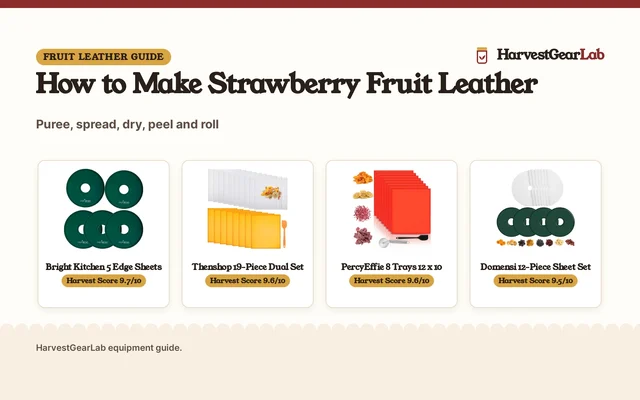
 Bright Kitchen Fruit Leather Silicone Dehydrator Sheets9.7/10View on Amazon
- 2
 Magic Mill Replacement Fruit Roll Trays for MFD-50009.3/10View on Amazon
- 3
 OdoVow Two-Tier Ceramic Fruit Bowl with Metal Stand9.2/10View on Amazon
- 4
 6 Pack Silicone Dehydrator Trays Compatible with CosoriView on Amazon
- 5
 Set of 3-14" x 14" -Silicone Re-Usable Non-Stick UltraView on Amazon
- 6
 4 Fruit Leather Silicone Dehydrator Sheets with EDGESView on Amazon
- 7
 Set of 3-14" x 14" Edge Silicone Sheets for ExcaliburView on Amazon
- 8
 2 Edge Fruit Leather Silicone Dehydrator Sheets for NescoView on Amazon
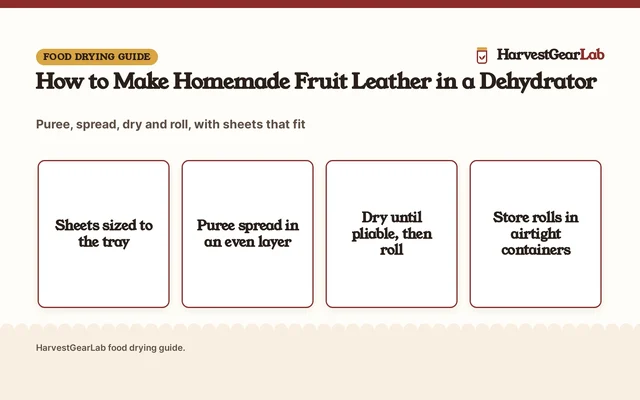
A basket of soft fruit at the end of summer, too ripe to eat fresh and too much for a jam pot, is the moment to learn how to make fruit leather in oven. Spread smooth fruit puree in a thin layer on a lined tray, dry it in the oven on low heat with the door open a crack for air, and peel the sheet off the liner when it feels pliable and dry to the touch. This guide walks through the tray, the spread, the drying, and the storage.
Runners-up to consider
 6 Pack Silicone Dehydrator Trays Compatible with CosoriCheck price on Amazon
 Set of 3-14" x 14" -Silicone Re-Usable Non-Stick UltraCheck price on Amazon
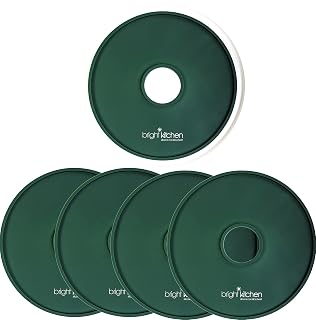 4 Fruit Leather Silicone Dehydrator Sheets with EDGESCheck price on Amazon
 Set of 3-14" x 14" Edge Silicone Sheets for ExcaliburCheck price on Amazon
 5 Fruit Leather Silicone Dehydrator Sheets EDGES Fits CosoriCheck price on Amazon
 2 Edge Fruit Leather Silicone Dehydrator Sheets for NescoCheck price on Amazon
HarvestGearLab earns a commission when you buy through links on this site, at no extra cost to you. As an Amazon Associate I earn from qualifying purchases. Affiliate disclosure.
How to make fruit leather in oven: the short version
Fruit leather is fruit puree dried into a flexible sheet that peels off its liner, rolls up, and keeps in an airtight container. The oven method needs a rimmed sheet pan or a silicone tray with a raised edge, a liner that releases the sheet, and low heat with air moving through the oven. The table below lists the sizes current listings state.
| Tray | Stated size | Pack | Notes |
|---|---|---|---|
| Thenshop silicone set | 11.8 x 11.8 inches | 10 sheets and 8 mats | 0.4 inch raised edge |
| PercyEffie silicone trays | 11.8 x 10.6 inches | 6 pack | Fits Cosori CP267-FD |
| Cosori fruit roll sheets | 11.73 x 11.57 inches | 2-pack | Fits CFD-N051-W, 5 trays |
| Nuenen non-stick trays | 12.2 x 12.2 inches | 4 pack | 0.8mm thickness |
| Cosori P501-SUS sheets | 9.21 x 8.86 inches | 2-pack | Fits P501-SUS, 5 trays |
Note the Thenshop listing states the counts in opposite order in its title and its bullets, so count the pieces when the box arrives.
Start with ripe fruit and a smooth puree
Start with fully ripe fruit, since ripe fruit brings the flavor and the sweetness the sheet needs. Wash the fruit, remove pits, stems and bruised spots, and cook it gently until soft enough to blend. A blender or food mill turns the cooked fruit into a smooth puree. A smooth puree spreads in an even layer and dries at an even pace, so blend out lumps first.
Line the tray and spread the puree
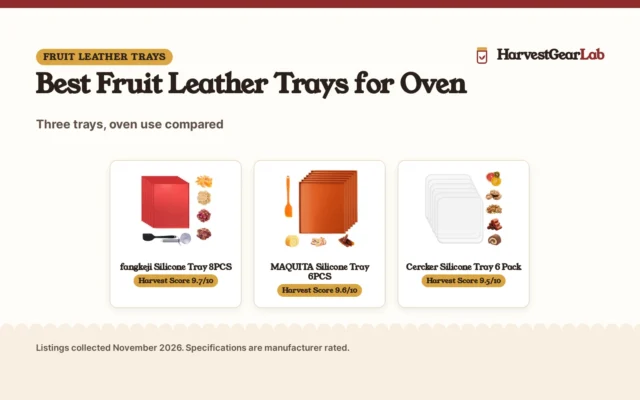
Line a rimmed sheet pan with a silicone sheet or parchment, or set a silicone tray with a raised edge on the pan. The edge matters: the Thenshop set states a 0.4 inch raised edge, and the PercyEffie trays (on Amazon) use a raised edge design, so the puree stays on the tray instead of running onto the oven floor. Spread the puree in a thin, even layer, leaving the edges a little thicker than the middle, since thin edges dry first and can turn brittle.
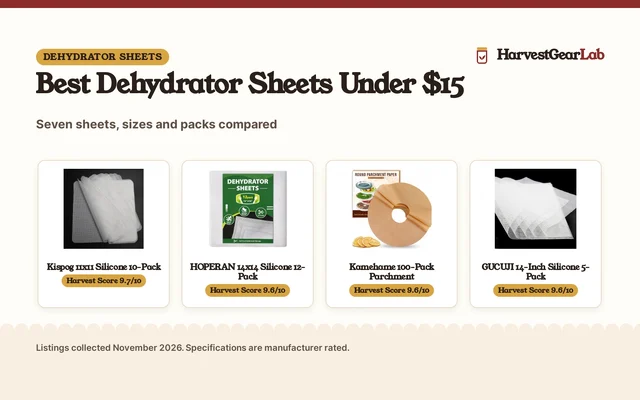
Match the liner to the pan before spreading anything. The Thenshop mesh sheets (on Amazon) measure 11.8 x 11.8 inches and the edged trays measure 12.2 x 10.2 inches, and the PercyEffie inner liner measures 11.8 x 10.6 inches. Nuenen states its trays at 12.2 x 12.2 inches and asks buyers to measure their trays before ordering. See the fruit leather trays for the oven guide and the dehydrator sheets guide for liners sized for common pans.
Dry it in the oven
Set the oven to its lowest setting and leave the door open a crack so moist air can escape while the puree dries. Low heat with moving air is the whole method, and a closed door traps the moisture the puree is giving off. Slide the pan onto a middle rack and keep the liner flat.
Check the sheet by touch as it dries. A finished sheet peels cleanly off the liner, bends without cracking, and shows no damp or sticky spots. Edges dry ahead of the middle, so check the middle last. The listings state the heat range of the liners: Thenshop states -40 degrees to 240 degrees, and PercyEffie states -86°F to 220°F. Alternative drying methods covers the dehydrator and sun drying routes when the oven is busy.
Use a dehydrator tray instead
A food dehydrator with fruit roll sheets gives the same result. Cosori lists fruit roll sheets for the CFD-N051-W, a 5 tray dehydrator, at 11.73 x 11.57 inches in a 2-pack, and a matching set for the P501-SUS at 9.21 x 8.86 inches, also in a 2-pack with a 2 year manufacturer warranty. Both sets are BPA-free and hand wash only, not dishwasher safe.
Magic Mill lists replacement fruit leather trays as a 4 pack for model numbers MFD-7070, MFD-9100, MFD-7100 and MFD-6060, and a 5 pack for the MFD-5000. Match the model number on the dehydrator before ordering, since a tray made for one model may not sit flat in another. The dehydrators for fruit leather guide and the best food dehydrator guide compare the machines, and dehydrator sheets vs dehydrator trays explains which liner suits liquids.
Peel, roll and store
Let the sheet cool on the tray before peeling it, since a warm sheet tears more easily than a cool one. Peel from a corner and roll the sheet up with the liner or a strip of parchment between the layers so the roll does not stick to itself. Store the rolls in an airtight container in a cool, dry cupboard; the airtight containers for dried fruit guide compares jars and canisters that seal well. Keep each batch in its own container with the fruit and the date marked on the lid.
What to skip or verify
- Silicone mats without a hard tray: PercyEffie states the silicone cannot be used alone and must sit on a hard tray, so slide a metal tray under the mat first.
- Hand wash only sheets: Cosori states its fruit roll sheets are hand wash only and not dishwasher safe.
- Wrong model trays: Magic Mill lists its 4 pack for MFD-7070, MFD-9100, MFD-7100 and MFD-6060: match the model number before ordering.
- Unmeasured liners: Nuenen asks buyers to measure their trays before ordering: an 11.8 x 11.8 inch sheet and a 12.2 x 12.2 inch tray do not fit the same pan.
- Canning jars in the oven: an oven is for drying fruit leather, not for sealing canning jars, so never put jars in the oven to seal them.
- Counts in the listing: the Thenshop title and bullets state the sheet and mat counts in opposite order, so count the pieces when the box arrives.
What this guide does not cover
This guide covers the method, the tray and the storage, and it does not give a recipe, a drying time or an oven temperature. Those depend on the fruit, the thickness of the spread and the oven, so take them from current USDA and National Center for Home Food Preservation guidance. Every drying guide on the site is collected in the food drying section.
FAQ: preserving at home
Can I make fruit leather in the oven without a dehydrator?
Yes. Spread smooth puree on a lined tray, dry it in the oven on low heat with the door open a crack, and peel the sheet off the liner when it feels pliable and dry to the touch.
What size tray do I need for fruit leather?
Match the liner to the pan: current listings state 11.8 x 11.8 inches, 12.2 x 10.2 inches, 11.73 x 11.57 inches and 9.21 x 8.86 inches.
How do I know when fruit leather is dry?
The sheet peels cleanly off the liner, bends without cracking, and shows no damp or sticky spots. Check the middle last, since the edges dry ahead of it.
Are silicone dehydrator sheets made for oven heat?
The listings state the range for each sheet: Thenshop states -40 degrees to 240 degrees, and PercyEffie states -86°F to 220°F, with food-grade silicone that is BPA-free. Match the sheet to the heat used.
How should I store fruit leather after drying?
Let the sheet cool, peel it, roll it with parchment between the layers, and keep the rolls in an airtight container. Mark the fruit and the date on the lid so the oldest batch gets used first.
More preserving guides
See every food drying guide and all food dehydrators guides.
More picks: fruit leather trays for the oven, dehydrators for fruit leather, dehydrator sheets and airtight containers for dried fruit.