
On this page
Top picks at a glance
As an Amazon Associate I earn from qualifying purchases.
- 1
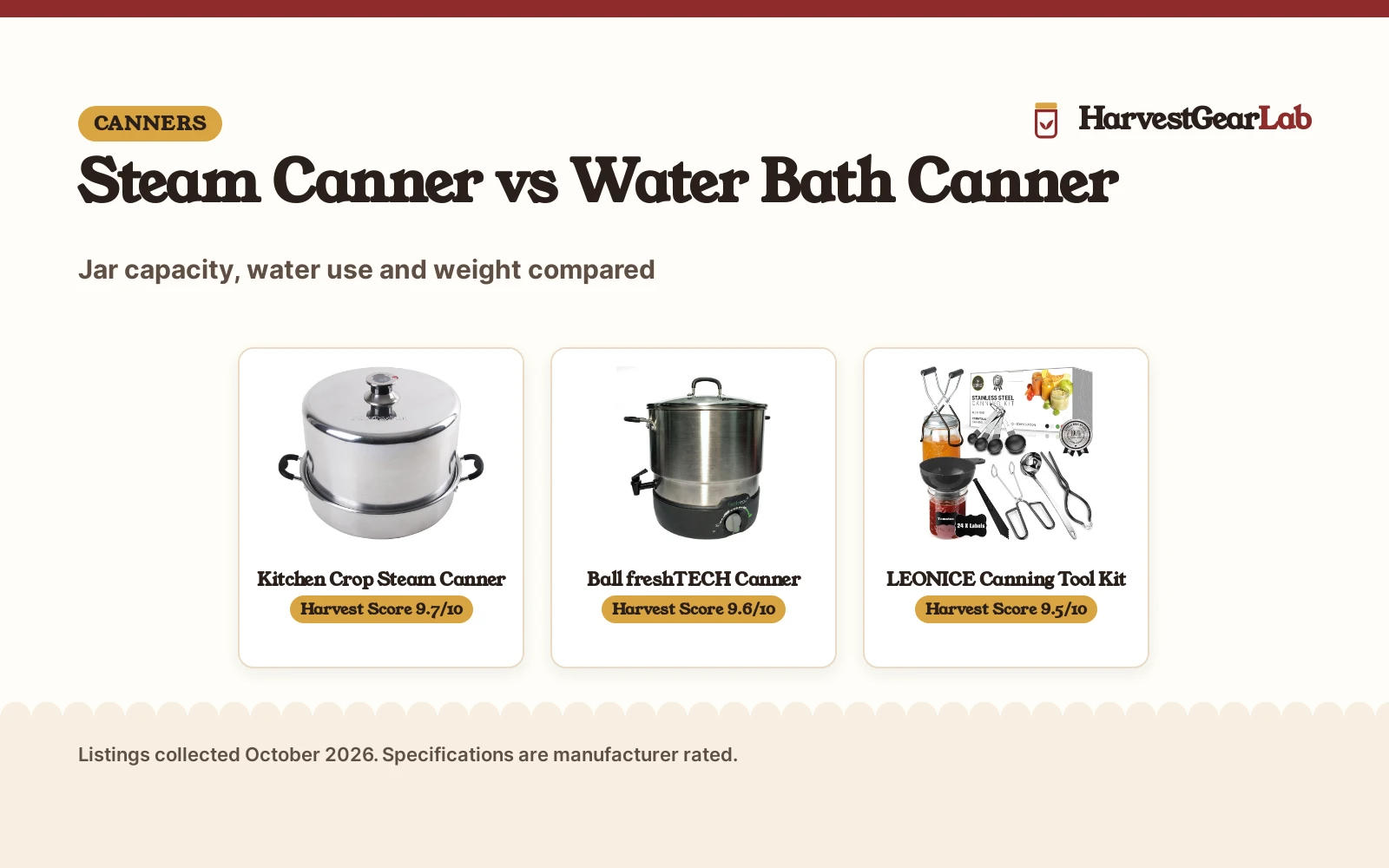
 Kitchen Crop Steam Canner9.7/10View on Amazon
- 2
 Ball freshTECH Canner9.6/10View on Amazon
- 3
 LEONICE Canning Tool Kit9.5/10View on Amazon
The steam canner vs water bath canner choice comes down to speed against simplicity, and we compared one steam canner listing with two water bath listings to show it. Pick the steam canner if you want the fastest heat-up with the least water: the Kitchen Crop example processes up to 7 quart or 8 pint jars with only 2-1/2 quarts of water. Pick the water bath side if you want an electric unit that also cooks, like the Ball freshTECH example with its 21-quart capacity, or a starter tool kit like the LEONICE example with 24 jar labels.
HarvestGearLab earns a commission when you buy through links on this page, at no extra cost to you. As an Amazon Associate I earn from qualifying purchases. Affiliate disclosure.
Quick verdict: choose the steam canner if you process high-acid foods in batches of up to 7 quart jars and want less water to heat and haul; the Kitchen Crop example states 80% less water than traditional water bath canning and a 4.2 pound weight. Choose the water bath side if you want an electric canner that doubles as a multi-cooker, or a complete tool kit for a pot you already own. Steam wins on stated speed and water use; the water bath side wins on versatility, since the Ball example cooks pastas, soups, vegetables and seafood.
Three examples
| # | Product | Harvest Score | Buy |
|---|---|---|---|
| 1 | Kitchen Crop Steam Canner | 9.7/10 | Buy on Amazon |
| 2 | Ball freshTECH Canner | 9.6/10 | Buy on Amazon |
| 3 | LEONICE Canning Tool Kit | 9.5/10 | Buy on Amazon |

Kitchen Crop Steam Canner
An aluminum steam canner that processes up to 7 quart or 8 pint jars with 2-1/2 quarts of water, for a canner who wants the fastest stated heat-up; skip it if you need jars larger than quart size.
Pros
- Processes up to 7 quart or 8 pint jars with only 2-1/2 quarts of water, stated
- The listing states 80% less water and preheating time cut by 50% against traditional water bath canning
- Cool-touch handles and a built-in temperature indicator in the lid knob
- Light at 4.2 pounds with a 13 by 16.5 by 11 inch footprint
Cons
- For acidified or naturally acidic foods only, per the listing
- The listing note says it will not fit jars larger than quart size
- Hand wash only, per the product care instructions

Ball freshTECH Canner
A 21-quart electric water bath canner and multi-cooker with a glass lid and jar rack, for a canner who wants an electric unit that also cooks; skip it if you have no nearby outlet.
Pros
- 21-quart electric canner that holds 7 quarts or 8 pints, stated
- Doubles as a multi-cooker and steamer for pastas, soups, vegetables and seafood
- One simple dial controls temperature; uses 20% less energy than stove top, per the listing
- Removable jar rack and an easy-drain spigot are stated
Cons
- Electric only, so it needs an outlet near the counter
- 1 Year Manufacture Limited warranty, shorter than the steam canner's stated term

LEONICE Canning Tool Kit
A food-grade stainless steel canning tool kit with ladle, funnel, lifters and 24 labels, for a beginner who already owns a large pot; skip it if you are shopping for the canner itself.
Pros
- Food-grade stainless steel tools: ladle, funnel, 4 measuring cups, 3-in-1 bubble remover, lid lifter, jar lifter, jar wrench and tongs
- 24 jar labels are included
- Funnel fits both regular and wide-mouth jars
- Weighs 1.39 pounds, so the kit stores in a drawer
Cons
- A tool kit, not a canner: you still need a pot
- No warranty term is stated
- The title names pressure canners too, so it is not water-bath-only gear
- No dimensions are stated for the individual tools
As an Amazon Associate I earn from qualifying purchases.
Runners-up to consider
 24.5QT Electric Water Bath CannerCheck price on Amazon
 Ball EasyCanner Electric Water Bath CannerCheck price on Amazon
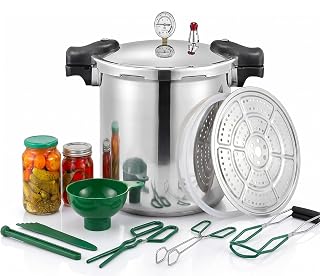 25 Quart Pressure Canner Cooker & pressure canners forCheck price on Amazon
 Electric Water Bath Canner 27 QuartCheck price on Amazon
 15 quart Jar Stove Top Water Bath CannerCheck price on Amazon
 Kitchen Crop Steam Canner with Temperature IndicatorCheck price on Amazon
Steam canner vs water bath canner: side by side
| Canner | Harvest Score | Side | Jar capacity | Weight | Warranty | Amazon |
|---|---|---|---|---|---|---|
| Kitchen Crop Steam Canner | 9.7/10 | Steam canner | 7 quart or 8 pint jars | 4.2 lb | 5-year (bullets) | View on Amazon |
| Ball freshTECH Canner | 9.6/10 | Water bath canner | 7 quarts or 8 pints | Unclear (16 oz listed) | 1 Year Manufacture Limited | View on Amazon |
| LEONICE Canning Tool Kit | 9.5/10 | Water bath tools | Not a canner | 1.39 lb | Not stated | View on Amazon |
Numbers in this comparison come from the maker as the listing shows them, checked 17 October 2026.
What each canner is for
The Kitchen Crop listing says its steam canner is just as safe and effective as water bath canners when properly used for acidified or naturally acidic foods. The Ball listing describes an electric water bath canner that doubles as a multi-cooker, and the LEONICE listing sells tools for water bath and pressure canners alike. Recipes, processing times and pressures are not covered here; take them from current USDA and National Center for Home Food Preservation guidance for each food. Our canning section groups every canner and tool guide in one place.
Water, weight and heat-up
Water is the clearest stated difference. The Kitchen Crop example needs only 2-1/2 quarts of water to process up to 7 quart or 8 pint jars, and the listing states 80% less water and preheating time cut by 50% against traditional water bath canning. The Ball example lists a 21-quart capacity with room for 7 quarts or 8 pints, and states 20% less energy use than stove top models. On weight, the Kitchen Crop example lists 4.2 pounds and the LEONICE kit lists 1.39 pounds, but the Ball spec table lists 16 ounces, which does not fit a 21-quart electric canner, so we treat its weight as unclear rather than calling either side lighter.
Lids, racks and extras
The Kitchen Crop example carries a built-in temperature indicator in the lid knob and cool-touch handles. The Ball example lists a tempered glass lid, a steaming and canning jar rack, a recipe book, one simple dial and an easy-drain spigot. The LEONICE example is all extras: a jam ladle, a funnel for regular and wide-mouth jars, 4 measuring cups, a 3-in-1 bubble remover and headspace tool, a magnetic lid lifter, a jar lifter, a jar wrench, tongs and 24 jar labels. If you are weighing a pressure canner instead, our water bath canner vs pressure canner comparison covers that choice.
Listing gaps to check
The Kitchen Crop bullets promise a 5-year warranty while the spec table says 2 year limited warranty; we trust the bullets, but ask the seller which term applies. The Ball spec table lists 16 ounces of weight and 21 liters of capacity against the bullets’ 21-quart capacity, so the weight stays unclear and the bullets win on capacity. The LEONICE listing states no warranty term at all. None of the three listings names a certification, so we scored safety on stated features like handles, indicators, lids and racks.
Which should you choose?
Choose the steam canner if you process high-acid foods in batches of up to 7 quart or 8 pint jars, you want the fastest stated heat-up, and you would rather heat 2-1/2 quarts of water than fill a big pot.
Choose the water bath side if you want an electric canner that also cooks pastas, soups, vegetables and seafood, or a complete tool kit for the pot you already own. Start with the water bath canners section to compare sizes.
Whichever you pick, a jar lifter, funnel and lid lifter belong in the kitchen; our best canning tool kit for beginners covers starter sets.
In the Preserving Kitchen
- Match the batch to the jar count: the Kitchen Crop example holds up to 7 quart or 8 pint jars, and the Ball example holds 7 quarts or 8 pints.
- Keep the Kitchen Crop hand wash only, per its care instructions; the Ball example lists an easy-drain spigot for emptying.
- Store the LEONICE tools together in one box so the jar lifter, funnel and lid lifter are at hand on canning day.
- Check cool-touch handles, the lid temperature indicator and the tempered glass lid for damage before each canning season.
How the Harvest Score played out
| Product | Harvest Score | Perf. /35 | Build /25 | Value /25 | Safety /10 | Warranty /5 |
|---|---|---|---|---|---|---|
| Kitchen Crop Steam Canner | 9.7 | 29 | 21 | 21 | 7 | 4 |
| Ball freshTECH Canner | 9.6 | 28 | 20 | 20 | 7 | 2 |
| LEONICE Canning Tool Kit | 9.5 | 23 | 20 | 21 | 6 | 0 |
Harvest Scores sit on a narrow band from 9.2 up to 9.8. Each tool’s weighted points are converted onto it proportionally, and a higher total always gives a higher number.
The Harvest Score weighs performance, build, value, safety and warranty. For canners, safety means the stated features that keep hot water and jars under control: cool-touch handles and the lid temperature indicator on the Kitchen Crop, the tempered glass lid and jar rack on the Ball, and the jar lifter, tongs and lid lifter in the LEONICE kit. The Kitchen Crop scores highest for its stated speed and capacity with the least water; the Ball follows for its electric multi-cooker versatility; the LEONICE kit trails because it is tools, not a canner, and states no warranty. How we pick explains the weights.
FAQ: preserving at home
Does a steam canner use less water than a water bath canner?
The Kitchen Crop listing states it uses 80% less water than traditional water bath canning, needing only 2-1/2 quarts of water for up to 7 quart or 8 pint jars.
Can the Ball freshTECH replace a stove burner?
The listing describes an electric water bath canner and multi-cooker with one dial and states 20% less energy use than stove top models, so it runs without a burner.
What does the LEONICE kit include?
The listing states a jam ladle, a funnel for regular and wide-mouth jars, 4 measuring cups, a 3-in-1 bubble remover and headspace tool, a magnetic lid lifter, 24 jar labels, a jar lifter, a jar wrench and tongs, in food-grade stainless steel.
Which of these has the longest stated warranty?
The Kitchen Crop bullets state a 5-year warranty, though the spec table says 2 year limited warranty. The Ball states 1 Year Manufacture Limited, and the LEONICE kit states no term.
More preserving guides
See every water bath canners guide and all canning guides.
More picks: canning tool kits, water bath vs pressure canner, canning equipment checklist.