
On this page
Top picks at a glance
As an Amazon Associate I earn from qualifying purchases.
- 1
 VEVOR Electric Tomato Strainer9.6/10View on Amazon
- 2
 Hurom H330 Juicer9.8/10View on Amazon
- 3
 Reber Electric Tomato Strainer N.3 450W for Tomato Sauce andView on Amazon
- 4
 Weston Deluxe Electric Tomato StrainerView on Amazon
- 5
 OMRA Spremy Electric Tomato Strainer 1/4 HP Model 850 Brand:View on Amazon
- 6
 Newhai Electric Tomato StrainerView on Amazon
Both make tomato juice, but a tomato strainer and a juicer do it differently: a strainer crushes and sieves out skins and seeds for thick sauce, while a juicer extracts clear juice and leaves the pulp behind. Pick the strainer for sauce, salsa and puree; pick the juicer for drinking juice and clear tomato water. The reference listings here are all strainers, so every figure below comes from those listings and the juicer side is explained without figures.
Runners-up to consider
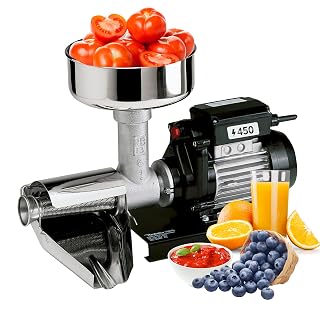 Reber Electric Tomato Strainer N.3 450W for Tomato Sauce andCheck price on Amazon
 Weston Deluxe Electric Tomato StrainerCheck price on Amazon
 OMRA Spremy Electric Tomato Strainer 1/4 HP Model 850 Brand:Check price on Amazon
 Newhai Electric Tomato StrainerCheck price on Amazon
HarvestGearLab earns a commission when you buy through links on this page, at no extra cost to you. As an Amazon Associate I earn from qualifying purchases. Affiliate disclosure.
Tomato strainer vs juicer: the short answer
Choose a tomato strainer when the goal is sauce: it separates skins and seeds from pulp and juice, giving a thick base for canning, ketchup and salsa. Choose a juicer when the goal is a drink: it extracts the liquid and discards most of the pulp, giving a thin, clear result. Many harvest kitchens end up with both, since neither does the other’s job well. For the strainer family, our best tomato strainer for ketchup compares the options.
Tomato strainers: what the listings state
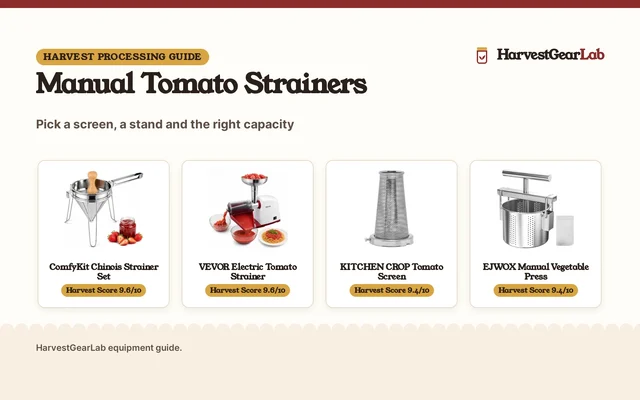
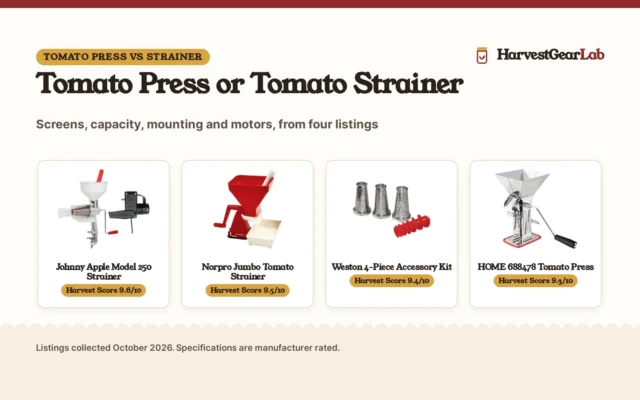
The strainers here split into manual and electric. The KITCHEN CROP Johnny Apple Sauce Maker, Model 250, lists a hand crank with an optional electric motor, a 1.3 mm hole screen, a clamp fitting countertops from 3/4 in to 2-1/8 in thick, 4.3 pounds, and a 5 year warranty. The motor bundle lists 8 pounds with screens of 1 mm, 1.3 mm, 2.86 mm and 5.8 mm holes for berries, tomatoes, pumpkin and salsa.
Electric strainers scale up fast. The Reber N.3 lists a 450W induction motor processing up to 309 lbs of tomatoes per hour, at 21 pounds and 110 volts, with a stainless AISI 304 filter cone. The Weston Deluxe lists a 250W motor at 120 volts with a 1 gallon capacity and a one-year manufacturer’s warranty. The AIRMSEN lists 2500W peak power and about 2 kg of ingredients per minute in a 12.6 in by 6.3 in by 12.6 in body.
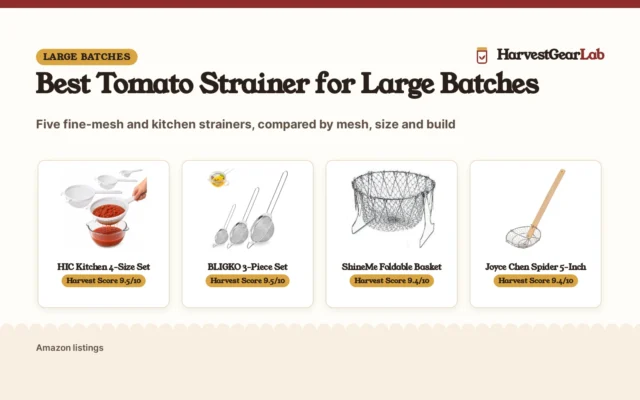
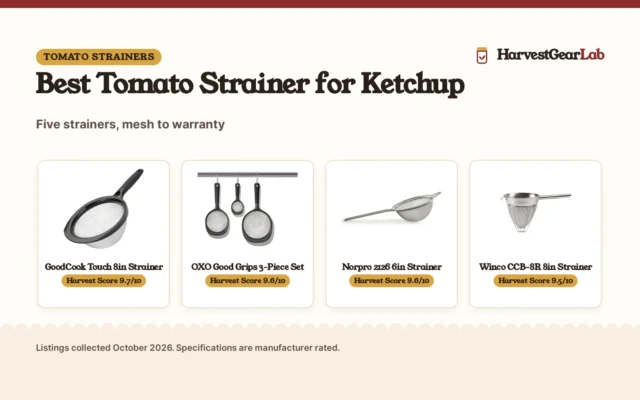
Small-batch tools round out the set. The KitchenAid KSMFVSP strainer attachment lists a 1 year warranty at 1.4 pounds. The Norpro chinois lists a 0.5 mm mesh in a 17 in by 9.5 in by 7.5 in set at 1.9 pounds, fitting 4 to 10 quart pots. The Weston cone lists a 2 quart, 1.9 liter capacity with 1.5 mm mesh and a one year warranty at 2.7 pounds. For the strainer versus mill question, see our victorio strainer vs food mill guide.
Juicers: strengths and tradeoffs
A juicer grinds or presses produce and separates the juice from the pulp, which is the opposite emphasis from a strainer. For drinking, that is ideal: the result is smooth, thin and pulp-free. For sauce, it is a problem: the pulp that gives sauce its body ends up in the waste bin, and most juicers choke on tomato skins and seeds unless the tomatoes are peeled and cored first.
Juicers also suit smaller batches better. Running bushels through a juicer takes far longer than through a 309 lb per hour electric strainer, and cleanup on a juicer is famously fiddly. No juicer listing appears in this reference set, so read any juicer listing for its stated power, capacity and cleaning notes before comparing it against the strainer figures above.
| Point | Tomato strainer | Juicer |
|---|---|---|
| Best for | Sauce, salsa, puree, ketchup | Drinking juice, clear tomato water |
| Output | Thick pulp and juice, skins removed | Thin juice, pulp discarded |
| Batch size listed | Up to 309 lbs per hour (Reber) | Suits small batches |
| Skins and seeds | Separated automatically | Often need peeling first |
| Cleanup | Screens rinse clean | More parts to scrub |
The strainer figures come from the reference listings above; the juicer column is qualitative because no juicer listing appears in this set.
Which suits your harvest
Canning season suits the strainer: sauce, salsa and ketchup all start with separated pulp, and the electric models handle bushel batches. The Weston Deluxe at 250W or the Reber at 450W turn a harvest day into jars; the manual KITCHEN CROP at 4.3 pounds suits smaller kitchens. A drinking habit suits the juicer: fresh tomato juice for breakfast is a juicer job. Our electric tomato juicer vs steam juicer guide covers the juicer side.
What this guide does not cover
This guide covers tool choice only. It does not give recipes, sauce processing times or canning instructions. Take those from current USDA and National Center for Home Food Preservation guidance, or from a current edition of a trusted canning guide, and follow them exactly for each food. Every harvest tool guide on the site is collected in our harvest processing section.
FAQ: preserving at home
Can a juicer make tomato sauce?
Poorly. A juicer discards the pulp that gives sauce body, and most juicers need peeled tomatoes. A strainer separates skins and seeds while keeping the pulp.
Which strainer here processes the most tomatoes?
The Reber N.3 at up to 309 lbs per hour with its 450W motor. The AIRMSEN lists about 2 kg per minute.
Which strainers state a warranty?
The KITCHEN CROP lists a 5 year warranty; the KitchenAid, Weston cone and Weston Deluxe state 1 year terms.
What screen sizes do the strainers use?
The KITCHEN CROP lists 1 mm, 1.3 mm, 2.86 mm and 5.8 mm screens; the Norpro uses 0.5 mm mesh and the Weston cone 1.5 mm.
Do strainers need electricity?
Not all. The KITCHEN CROP, KitchenAid attachment, Norpro and Weston cone are manual; the Reber, Weston Deluxe and AIRMSEN are electric.
More preserving guides
See every harvest processing guide and all steam juicer guides. Also see our victorio strainer vs food mill. Also see our food mill vs tomato strainer. Also see our best tomato strainer for ketchup.
More picks: browse electric tomato juicers, tomato juicer types and harvest baskets for tomatoes.