
On this page
Top picks at a glance
As an Amazon Associate I earn from qualifying purchases.
- 1
 Granite Ware 21.5 Qt Heavy Gauge Water Bath Canning Pot9.6/10View on Amazon
- 2
 Supa Ant 24 Quart Food-Grade Stainless Steel Water Bath9.6/10View on Amazon
- 3
 HOMKULA 27.5 Quart Water Bath Canning Pot with Rack9.6/10View on Amazon
What is canning food? It is the practice of sealing prepared food in jars and heating the filled jars so the food keeps on a pantry shelf. A counter full of tomatoes or a basket of apples at harvest time is where most canners start, and the jars that follow carry that harvest into the months after the garden quiets down. This guide explains the 2 methods, the jars and the canners, and what to check before a first batch.
Runners-up to consider
 21.5 Quart Water Bath CannerCheck price on Amazon
 Kitchen Canning FunnelCheck price on Amazon
 Dissolvable Food LabelsCheck price on Amazon
 LLIKED 240 Dissolvable Food Labels 1-1/2"x2-1/2 for CanningCheck price on Amazon
 LLIKED 120 Dissolvable Food Labels 1-1/2"x2-1/2 for CanningCheck price on Amazon
 3 Sizes of Kitchen Funnel SetCheck price on Amazon
HarvestGearLab earns a commission when you buy through links on this site, at no extra cost to you. As an Amazon Associate I earn from qualifying purchases. Affiliate disclosure.
What is canning food: the short answer
Canning food means putting prepared food into jars made for home canning, fitting a flat lid and a band, and heating the filled jars in a canner. The heat drives air out of the jar and the lid seals as the jar cools, so the food keeps without a freezer. Which canner you need depends on the food: high-acid foods go in a boiling water bath, and low-acid foods need a pressure canner. Pick the method before the pot, and take the method, the jar size and the recipe from current USDA and National Center for Home Food Preservation guidance.
The 2 methods
Every food you plan to put up falls into either of 2 groups, and the group decides the canner.
| Method | Foods | Canner |
|---|---|---|
| Water bath | High-acid foods: jams, jellies, pickles, salsa, acidified tomatoes | Water bath canner with rack and lid |
| Pressure | Low-acid foods: plain vegetables, meat, poultry, seafood, stock | Pressure canner |
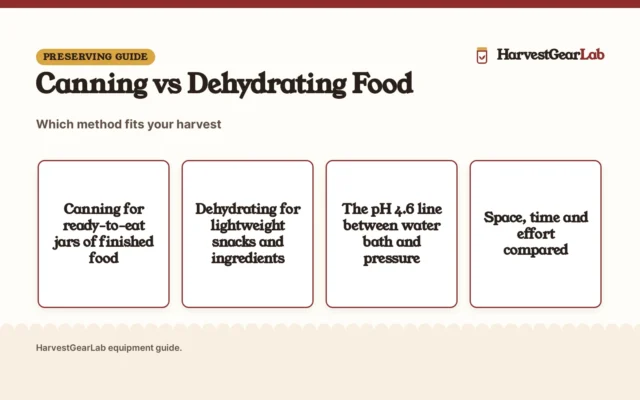
High-acid foods, such as most fruits, jams, jellies, pickles and tomatoes with added acid, can go in a boiling water bath when you follow a current USDA recipe. Low-acid foods, such as green beans, corn, potatoes, meat and stock, need a pressure canner, since boiling water alone does not get hot enough for them. If your list is all jam and pickles, a water bath canner is enough for now. Our canning process guide walks through the difference between the 2 methods.
Water bath canners: sizes from the listings
A water bath canner is a deep pot with a rack and a lid. The rack keeps jars off the bottom of the pot, and the lid holds the heat in. Canner volume in quarts is less useful than the jar count the maker states, so look for a listing that states the jar count rather than leaving you to guess.
The listings in this guide run from 21.5 quart pots to a 27.5 quart pot. The Granite Ware 21.5 (on Amazon) quart pot lists a rack that holds 7 quart jars, 9 pint jars or 12 half-pint jars, and the same 7, 9 and 12 jar counts appear in the other 21.5 quart enamel pots listed here. The Supa Ant pot (on Amazon) lists 24 quarts, and the HOMKULA pot (on Amazon) lists 27.5 quarts.
Check the base against your stove before you buy. The HOMKULA 27.5 quart pot states it is suitable for induction cooktops, while the 21.5 quart enamel pots listed here state they are not for glass or induction cooktops. The HOMKULA and Supa Ant pots list stainless steel, the Granite Ware pot lists porcelain on steel, and the other 21.5 quart pots list enamel steel. Compare current options in our canning pot sizes guide.
Jars, lids and bands
Use jars made for home canning, in the sizes your recipes call for. Half-pints suit jams and jellies, pints suit most vegetables and sauces, and quarts suit whole fruit, tomatoes and stock. Jars and bands can be reused for years if they are free of chips and rust, but the flat lids with sealing compound are made for a single use. Buy more lids than you think you need, since a nicked rim or a lid that does not seal sends you back to the box.
Mixing wide-mouth and regular-mouth jars is fine, but you will need lids and bands for both sizes and a funnel that fits both openings. The Granite Ware funnel states it fits both standard and wide-mouth canning jars. See our types of canning jars guide for the sizes and mouth styles.
Hand tools that handle hot jars
A few tools make canning day safer and much less messy:
- Jar lifter: grips the neck of a hot jar so you can lift it straight out of boiling water.
- Wide-mouth funnel: keeps food and syrup off the jar rim, where it can stop the lid from sealing.
- Magnetic lid lifter: picks warm lids out of a pan without touching the sealing compound.
- Bubble remover and headspace tool: releases trapped air and helps you match the headspace your recipe gives.
- Jar wrench: tightens or loosens lid bands, in quart, pint and half-pint sizes.
- Canning rack: keeps jars off the bottom of the pot; check whether your canner already includes one.
These usually come together in a kit. The HOMKULA kit lists a funnel, jar lifter, magnetic lid lifter, tongs, jar wrench, bubble remover with measurer, jam spoon, 100 date label stickers and a pair of heat-resistant gloves, with jars not included. The Supa Ant kit lists a measuring cup set, canning funnel, jar lifter, bubble popper and measurer, magnetic lid lifter, jar wrench, canning tongs and 90 Homemade labels. The Granite Ware 9-piece set lists a 5-piece toolset of bubble remover and ruler, jar lifter, magnetic lid lifter, jar wrench and jar funnel. Our canning tools section lines up the sets by pieces and materials.
What to skip or double-check
- Processing jars in an oven: skip it. Dry oven heat is not a safe way to process canning jars.
- Electric pressure cookers: do not use an electric pressure cooker for canning unless the maker states it is made for pressure canning.
- Small stovetop cookers sold as cooker and canner: check that the listing states a quart jar capacity before you treat it as a pressure canner.
- Old or secondhand canners: check the gauge, seal and safety plug before use, and ask your local extension office whether they can check a dial gauge.
- Reused single-use lids: buy new flat lids each season.
- Stove fit: confirm the pot suits your cooktop, since some enamel pots state they are not for glass or induction cooktops.
What this guide does not cover
This is an explainer, not a recipe book. It does not give recipes, processing times, pressures, headspace figures or altitude changes. Take those from current USDA and National Center for Home Food Preservation guidance and follow them exactly for each food. Every canner and tool guide on the site is collected in our canning section, and how to start canning walks through the gear a beginner needs.
FAQ: preserving at home
What is canning food?
Canning food means sealing prepared food in jars and heating the filled jars so the food keeps on a pantry shelf. High-acid foods use a boiling water bath and low-acid foods need a pressure canner.
What foods can be water bath canned?
High-acid foods such as jams, jellies, pickles, salsa and acidified tomatoes. Plain vegetables, meat, poultry, seafood and stock are low-acid foods and need a pressure canner.
Do I need a pressure canner to start canning?
Only if you plan to can low-acid foods such as plain vegetables, meat, poultry, seafood or stock. If you start with jams, jellies, pickles and acidified tomatoes, a water bath canner is enough, and you can add a pressure canner later.
What size water bath canner fits a first batch?
A 21.5 quart pot with a rack that holds 7 quart jars, 9 pint jars or 12 half-pint jars suits a first batch for most beginners. The listings here also include a 24 quart pot and a 27.5 quart pot for bigger batches.
Can I reuse canning jars and lids?
Jars and bands can be reused as long as they have no chips, cracks or rust. The flat lids with sealing compound are made for a single use, so buy new lids for each batch.
More preserving guides
See every canning tools guide and all canning guides.
More picks: how to water bath can, what is a water bath for canning, canning pot sizes and how to start canning.