
On this page
Canning vs freezing food is the choice every gardener faces when the harvest comes in faster than the family can eat it. Canning puts jars on a pantry shelf where they keep with no power draw, while freezing holds food close to fresh with less work at the stove. Pick canning when you want shelf storage and a full pantry, and pick freezing when you want speed and texture; this guide walks through both sides and ranks the gear that fits each one.
HarvestGearLab earns a commission when you buy through links on this site, at no extra cost to you. As an Amazon Associate I earn from qualifying purchases. Affiliate disclosure.
Canning vs freezing food: the short answer
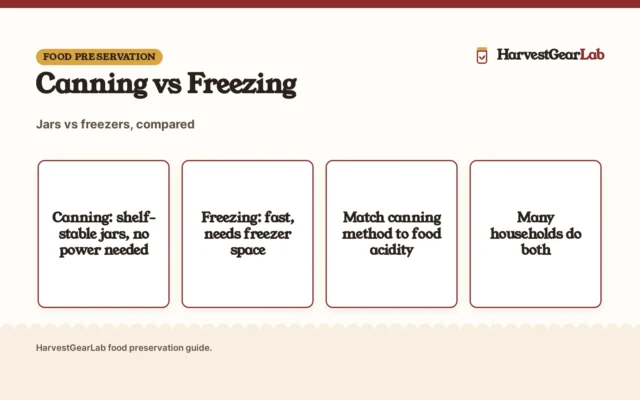
Both methods keep the harvest, and most preserving households use both. Canning suits foods you want to store on a shelf, while freezing suits foods you want to use soon and keep close to fresh. The table below sums up the trade-off.
| Method | Where it keeps | What it needs | Suits best |
|---|---|---|---|
| Canning | Jars on a pantry shelf | Canner, jars, lids, hand tools | Jams, pickles, tomatoes, sauces |
| Freezing | Portions in the freezer | Freezer space, trays or bags | Soups, stocks, berries, vegetables |
Start with the food, not the method
Before you buy anything, sort the foods you want to put up into groups. High-acid foods, such as most fruits, jams, jellies, pickles and tomatoes with added acid, can go in a boiling water bath when you follow a current USDA recipe. Low-acid foods, such as green beans, corn, potatoes, meat and stock, need a pressure canner. Boiling water alone does not get hot enough for them, and no amount of extra time in a water bath changes that.
If your list is all jam and pickles, a water bath canner is enough for now. If it includes plain vegetables or meat, you need a pressure canner. Our water bath canner vs pressure canner comparison walks through the difference.
The canning side: jars on the shelf
Canning starts with a canner that matches the foods you plan to preserve, canning jars with new lids and bands, and a small set of hand tools for moving hot jars. Canner volume in quarts is less useful than the jar count the maker states.
For a water bath canner, check that a rack is included, that the base suits your stove, and whether the listing mentions glass tops or induction. For a pressure canner, look for a stated gauge, a regulator weight and an overpressure plug or similar safety feature, and confirm it is sold as a canner, not only as a pressure cooker. Compare current options in our best water bath canner and best pressure canner guides.
A good canning tool kit bundles the jar lifter, funnel, lid lifter and bubble remover you need on the first day, and some include a rack. See our best canning tool kit comparison for sets lined up by pieces and materials.
The freezing side: portions and a full freezer
Freezing starts with freezer space and a way to portion food before it goes in. Silicone trays with lids turn soups, stocks and sauces into neat blocks that stack, and a tray with fill lines keeps portions even so a block matches a meal. Label every tray or bag before it goes in, and use older portions before newer ones.
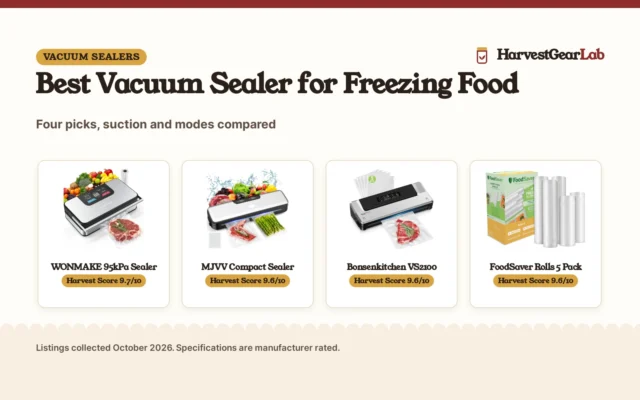
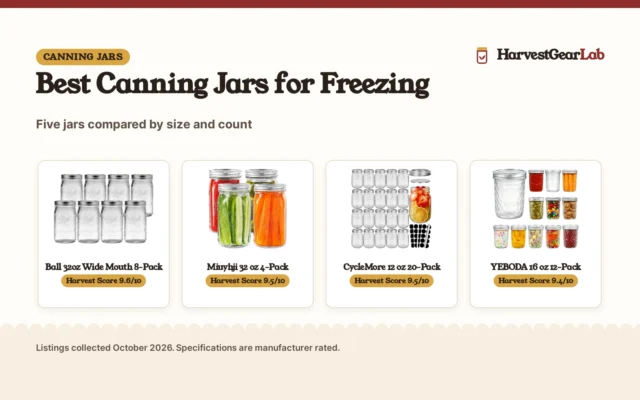
Mason jars can also go in the freezer when they are made for it and filled with room to expand; see our best mason jars for freezing guide for jars compared for that job. A vacuum sealer made for jars can help with dry goods and jar storage; see our best vacuum sealer for canning jars comparison. For a third path, drying suits herbs, fruit and jerky; see our best food dehydrator guide.
The gear that fits this choice
We ranked the gear below by how well each piece serves a canning or freezing household.
GGOW Silicone Freezer Tray, 2-cup, 2-pack
Top of the ranking for freezing. Each tray has fill lines at 1 cup (250 ml) and 2 cups (500 ml), and each cube measures 2.16 inches by 4.13 inches by 4.13 inches, so a block matches a meal-size portion of soup or stock. The pair of trays holds up to 8 cups of food, and the steel reinforced edges and tight-fitting lid keep the trays steady from counter to freezer. The trays stack, and cubes pop out with a gentle push from the bottom. The maker lists the tray at 6.0 inches by 4.0 inches by 2.0 inches.
GGOW Silicone Freezer Tray, 2-cup, 4-pack
Second in the ranking, and the pick when you want more trays on hand. The set includes 4 trays and freezes up to 8 cups of food, with the same fill lines at 1 cup (250 mL) and 2 cups (500 mL). Each tray measures 3.9 inches by 3.9 inches by 2.3 inches, and a stainless steel frame keeps it steady when full. The transparent lids keep freezer smells out and keep liquids from spilling. The trays are made from food-grade silicone.
KeaBabies Silicone Food Freezer Tray, 2 oz x 10 pods
Third in the ranking, and the pick for small portions. Each tray holds 2 oz x 10 pods, and the maker lists the tray at 9.3 inches by 7.7 inches by 2 inches. The trays are BPA-free, with a wide base that resists spills and a clip-on clear lid that keeps food fresh. They suit baby food, purees and breast milk, and the maker lists them as dishwasher and microwave safe. For bulk harvest freezing, the small pods sit below the larger portion trays.
The Complete Amish Survival Manual
Fourth in the ranking, and the reading pick for the canning side. The book covers canning, herbal remedies, DIY projects, survival skills and off-grid living, for background reading on self-sufficiency. The maker lists it at 8.5 inches by 0.62 inches by 11.0 inches. It ranks last here because it is a book, not equipment, and it does not freeze or can anything on its own.
What to skip or double-check
- Processing jars in the oven: skip it. Dry oven heat is not a safe way to process canning jars.
- Electric pressure cookers: do not use one for canning unless the maker states it is made for pressure canning.
- Reused single-use lids: buy new flat lids each season.
- Old or secondhand canners: check the gauge, seal and safety plug before use.
- Unlabeled freezer trays: label every portion before it goes in, or the freezer fills with mystery blocks.
What this guide does not cover
This is a method and gear guide. It does not give recipes, processing times, pressures, headspace figures or altitude changes. Take those from current USDA and National Center for Home Food Preservation guidance, and follow them exactly for each food. Every canner and tool guide on the site is collected in our canning section.
FAQ: preserving at home
Is canning or freezing better for tomatoes?
Canning suits sauces and whole tomatoes you want on a shelf, while freezing suits portions you will cook soon and want close to fresh.
Can I freeze soup in silicone trays?
Yes. Trays with 1 cup (250 ml) and 2 cups (500 ml) fill lines portion soup into meal-size blocks, and the flexible silicone pops cubes out with a gentle push from the bottom.
Do I need a pressure canner to start canning?
Only if you plan to can low-acid foods such as plain vegetables, meat, poultry, seafood or stock. If you start with jams, jellies, pickles and acidified tomatoes, a water bath canner is enough, and you can add a pressure canner later.
Can I reuse canning jars and lids?
Jars and bands can be reused as long as they have no chips, cracks or rust. The flat lids with sealing compound are made for one use, so buy new lids for each batch.
More preserving guides
See every canning tools guide and all canning guides.
More picks: water bath canners, pressure canners, canning tool kits and mason jars for freezing.