
On this page
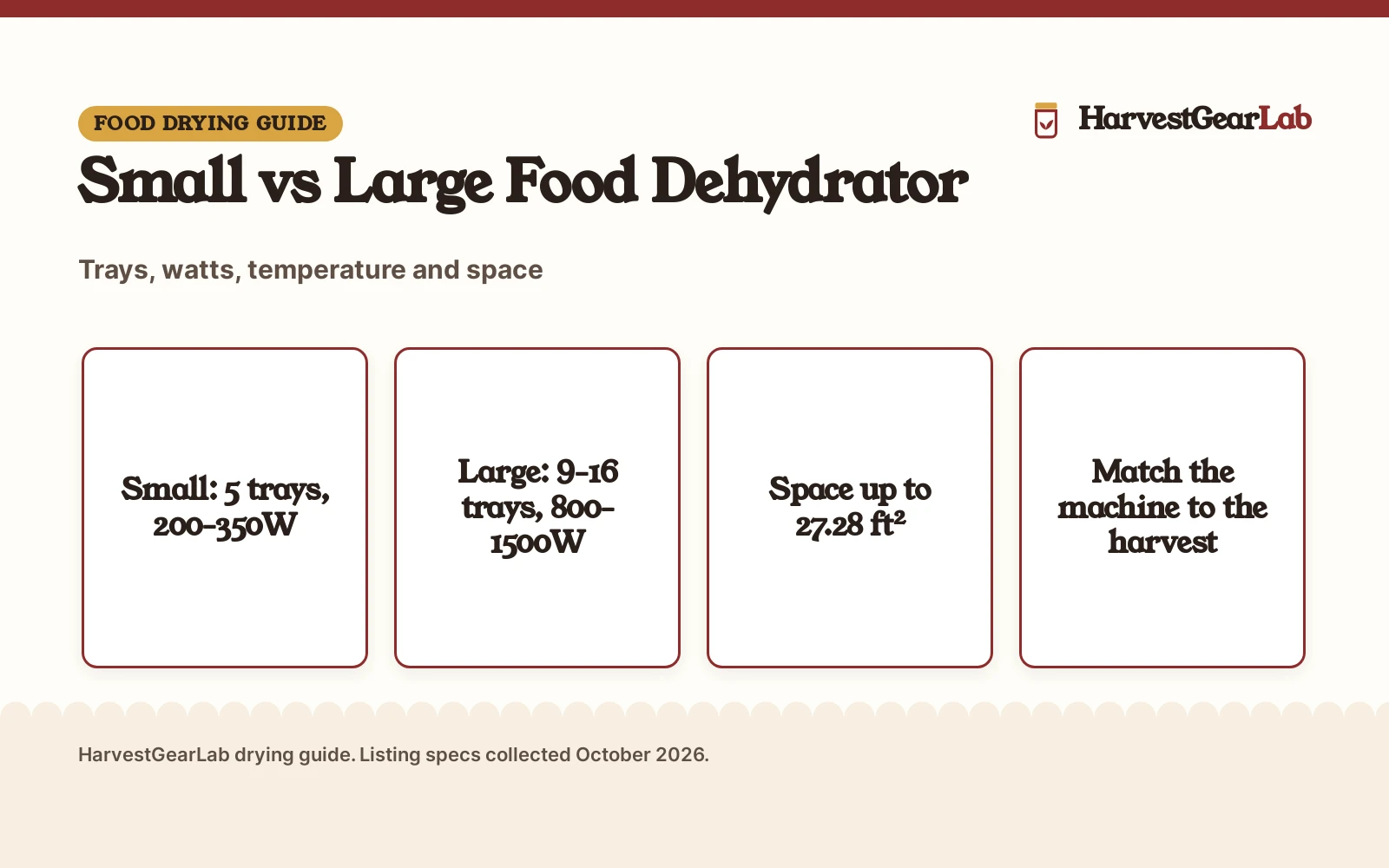
Small vs large food dehydrator comes down to batch size against counter space: small 5-tray models suit snacks, herbs and first batches, while 14 and 16-tray machines suit jerky runs and harvest season. The listings here draw 200 to 350W on the small side and 800 to 1500W on the large side, with drying space from a countertop stack to 27.28 ft². If drying is a weekly habit, go small; if it is a harvest-season operation, go large.
HarvestGearLab earns a commission when you buy through links on this site, at no extra cost to you. As an Amazon Associate I earn from qualifying purchases. Affiliate disclosure.
Choosing small vs large food dehydrator: the short answer
Choose small when the counter is tight and batches are modest: the Elite Gourmet listings draw 350W with 5 trays at 95 to 158°F, and the Daoseolo draws 200W with 5 trays in an 8.8 x 7.9 x 9.1 in box. Choose large when the garden produces by the crate: the Cercker 14-tray draws 1200W with 11.98 ft² of space, and the Cercker 16-tray draws 1500W with 27.28 ft². The fendia 9-tray at 800W sits in the middle for growers who have outgrown a countertop model but not a dedicated drying room.
What a small dehydrator gives you
A small dehydrator is a countertop appliance. The Elite Gourmet EFD329WD lists 5 BPA-free SlimStore collapsible trays at 12.50 in diameter, a 95 to 158°F range, a 48-hour timer adjustable in 30-minute increments, 350W, and trays that are dishwasher safe. The Elite Gourmet EFD329WDX repeats the 350W, 5-tray, 95 to 158°F, 48-hour timer formula at 11.6 x 11.6 x 6.17 in and 4.4 lb. The Elite Gourmet EFD319X lists 5 trays at 11.4 in, 350W, 95 to 158°F, ETL listed, 120V, 4.6 lb, dishwasher-safe trays on the top rack, and a 1-Year Warranty. The Daoseolo lists 5 trays, 200W, an 8.8 x 7.9 x 9.1 in footprint at 5.5 lb, BPA-free food-grade materials and overheating protection.
The small size has real advantages. Collapsible trays on the Elite Gourmet SlimStore models nest for storage. A 200 to 350W draw runs on any kitchen circuit without planning. Trays and lids go in the dishwasher. The limits are batch size and temperature ceiling: 95 to 158°F suits fruit, herbs and vegetables, and five trays fill fast when the tomatoes ripen all at once. See the stainless steel vs plastic dehydrator guide for material trade-offs.
What a large dehydrator gives you
A large dehydrator is a batch machine. The Cercker 14-tray lists 1200W at 120V, 14 stainless steel trays at 12.52 x 9.84 in, 11.98 ft² of space, a 70 to 190°F range in 5°F increments, a 24-hour timer, noise at or below 50 dB, and a 3-year warranty. The Cercker 16-tray lists 1500W, 16 trays at 15.7 x 15.7 in, 27.28 ft² of space, a 70 to 190°F range, a 0.5 to 24-hour timer, 316 food-grade stainless steel trays, a 3 Year Manufacturer warranty, and a 53.6 lb body at 21.45 x 16.53 x 24.8 in. The fendia 9-tray lists 800W, 9 trays at 11.42 x 11.42 in, an 86 to 194°F range, a 1 to 24-hour timer, a remote control, and a built-in automatic shut-off with overheating protection.
Large machines earn their footprint on volume and temperature. Trays measured in square feet dry a harvest in one run instead of three. A 190 to 194°F ceiling handles jerky, where the small 158°F ceiling does not. The trade-offs are space, power and weight: the Cercker 16-tray weighs 53.6 lb and needs a permanent spot. For jerky specifically, see the dehydrator vs smoker for jerky guide.
The middle ground
The fendia 9-tray at 800W is the bridge: 9 trays at 11.42 x 11.42 in, an 86 to 194°F range and a remote control, for growers who have outgrown five trays but do not need 14. If the choice is between one large machine and two small ones, one large machine dries more per batch and runs one timer; two small machines let fruit and jerky run at different temperatures. Count the trays against the harvest before deciding.
What this guide does not cover
This guide does not cover freeze dryers, smokers, herb drying racks or oven drying. It does not cover dehydrator sheets or accessories. For drying method comparisons, see the related guides below.
FAQ: preserving at home
How many watts do the listings draw?
The Daoseolo draws 200W, the Elite Gourmet models draw 350W, the fendia draws 800W, the Cercker 14-tray draws 1200W, and the Cercker 16-tray draws 1500W.
What temperature ranges are stated?
The Elite Gourmet models state 95 to 158°F, the Cercker models state 70 to 190°F, and the fendia states 86 to 194°F.
Which state a warranty?
The Cercker 14-tray and 16-tray state a 3-year warranty. The Elite Gourmet EFD319X states a 1-Year Warranty.
How much drying space do the large models list?
The Cercker 14-tray lists 11.98 ft², and the Cercker 16-tray lists 27.28 ft².
More preserving guides
See every food dehydrators guide and all drying guides.
More picks: dehydrator vs smoker for jerky, stainless steel vs plastic dehydrator, herb drying rack vs dehydrator and dehydrator vs oven drying.