
On this page
Top picks at a glance
As an Amazon Associate I earn from qualifying purchases.
- 1
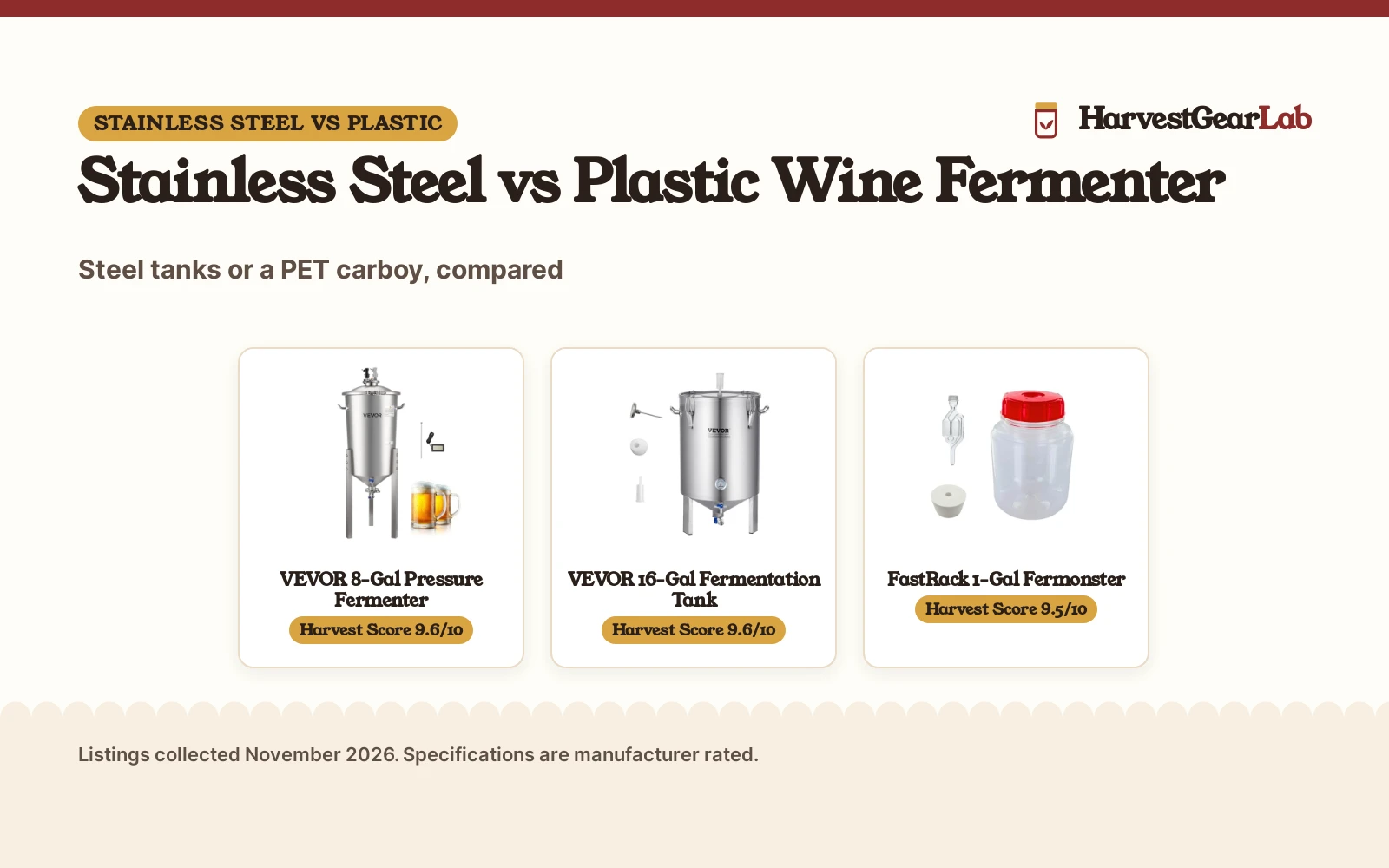
 VEVOR 8-Gal Pressure Fermenter9.6/10View on Amazon
- 2
 VEVOR 16-Gal Fermentation Tank9.6/10View on Amazon
- 3
 FastRack 1-Gal Fermonster9.5/10View on Amazon
When the grape harvest comes in and the juice is ready for the fermenter, the stainless steel vs plastic wine fermenter choice shapes how the batch is watched and cleaned. Stainless steel brings a sealed tank with valves and gauges, while plastic brings a light, clear carboy with the airlock in the box.
HarvestGearLab earns a commission when you buy through links on this page, at no extra cost to you. As an Amazon Associate I earn from qualifying purchases. Affiliate disclosure.
Quick verdict: pick stainless steel for large batches, valves, a sealed lid and live temperature readings; the VEVOR 16-gallon example holds 16 gallons with a yeast valve and a beer valve. Pick plastic for small batches and a light, clear carboy with the airlock included; the FastRack example holds 1 gallon.
Three examples
| # | Product | Harvest Score | Buy |
|---|---|---|---|
| 1 | VEVOR 8-Gal Pressure Fermenter | 9.6/10 | Buy on Amazon |
| 2 | VEVOR 16-Gal Fermentation Tank | 9.6/10 | Buy on Amazon |
| 3 | FastRack 1-Gal Fermonster | 9.5/10 | Buy on Amazon |
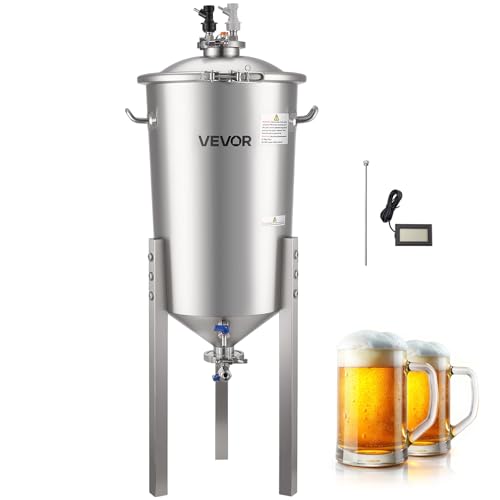
VEVOR 8-Gal Pressure Fermenter
An 8-gallon pressure fermenter in food-grade 304 stainless steel with a conical bottom, an electronic thermometer and adjustable legs.
Pros
- Pressure design rated at 15 PSI avoids CO2 overflow
- Electronic thermometer reads 32 to 104°F
- 304 stainless steel, 0.5 mm thick, smooth easy-clean surface
- Dual liter and gallon markings, reinforced handles
Cons
- Yeast bottle for consistent results is not included
- 8-gallon capacity holds less than the 16-gallon VEVOR tank
- No warranty term is stated
- Pressure fittings need more setup than a plain carboy

VEVOR 16-Gal Fermentation Tank
A 16-gallon 304 stainless steel fermenter with a conical bottom, yeast and beer valves, a sealed lid and a thermometer.
Pros
- 16-gallon capacity in food-grade 304 stainless steel, 0.5 mm thick
- Conical bottom with yeast slurry and beer valves
- Silicone sealing ring and clasp lid seal tight, no leakage even inverted
- Thermometer reads 32 to 104°F, Celsius and Fahrenheit
Cons
- No warranty term is stated
- Weighs 14.33 pounds empty, so a full load is heavy to lift
- Exhaust pipe needs water added to prevent backflow
- Tall body suits large batches, not small 1-gallon brews

FastRack 1-Gal Fermonster
A 1-gallon clear PET fermenter with a wide mouth, an airtight lid, a stopper and an airlock.
Pros
- 1-gallon size suits small-batch wine, beer, mead, cider
- Wide mouth and smooth, rib-free interior make cleaning simple
- Twin bubble airlock lets CO2 escape while keeping contaminants out
- Stopper and airlock included, ready for fermentation out of the box
Cons
- 1-gallon capacity suits small batches only
- No thermometer is stated
- Stopper and airlock are small parts to track
- No wall thickness is stated, while both steel tanks state 0.5 mm
As an Amazon Associate I earn from qualifying purchases.
Runners-up to consider
 30 Liter 6 Gallon Conical Fermenter with Bottle Filler andCheck price on Amazon
 laffeya Stainless Steel Fermenting Lids & Airlocks for WideCheck price on Amazon
 VEVOR Pressure Fermenter 15 PSICheck price on Amazon
 Norpro Stainless Steel Strawberry/Tomato Corer w/PlasticCheck price on Amazon
Stainless steel vs plastic wine fermenter: side by side
| Fermenter | Harvest Score | Side | Capacity | Material | Thermometer | Lid and Seal | Amazon |
|---|---|---|---|---|---|---|---|
| VEVOR 8-Gal Pressure Fermenter | 9.6/10 | Stainless steel | 8 gallons, 30L | 304 stainless, 0.5 mm | 32 to 104°F | Pressure design, 15 PSI | View on Amazon |
| VEVOR 16-Gal Fermentation Tank | 9.6/10 | Stainless steel | 16 gallons, 60L | 304 stainless, 0.5 mm | 32 to 104°F | Silicone ring, clasp lid | View on Amazon |
| FastRack 1-Gal Fermonster | 9.5/10 | Plastic | 1 gallon | PET plastic | Not stated | Airtight screw-on lid | View on Amazon |
Numbers in this comparison come from the maker as the listing shows them, checked 14 November 2026.
What each side is for
The steel side is built around large batches. Both VEVOR tanks use food-grade 304 stainless steel and conical bottoms. The 16-gallon tank adds a yeast slurry valve and a beer valve, while the 8-gallon tank adds a pressure design rated at 15 PSI.
The plastic side is built around small batches. The FastRack Fermonster is a 1-gallon clear PET carboy with a wide mouth, an airtight screw-on lid, a #10 drilled stopper and a twin bubble airlock. It suits wine, beer, mead and cider.
Capacity and batch size
Capacity is where the sides part ways. The steel tanks hold 16 gallons and 8 gallons, while the plastic carboy holds 1 gallon. Match the tank to the batch: a 1-gallon carboy leaves no room for a large batch, and a 16-gallon tank leaves a small batch swimming in headspace.
Material and cleaning
Both steel tanks state food-grade 304 stainless steel at 0.5 mm thick, with a smooth surface that cleans easily. The 16-gallon tank adds a silicone sealing ring and a clasp that seals tight. The plastic carboy is clear PET with a wide mouth and a smooth, rib-free interior, so cleaning stays simple. See glass carboy vs plastic carboy.
Temperature and pressure control
Both steel tanks carry a thermometer that reads 32 to 104°F, or 0 to 40°C. Only the 8-gallon tank adds pressure control, rated at 15 PSI to avoid CO2 overflow. The FastRack carboy states no thermometer, and its twin bubble airlock handles gas release instead. See how to use an airlock for fermentation.
Which should you choose?
Choose stainless steel if you ferment large batches and want valves, a sealed lid and live temperature readings. Compare more options in the best thermometer for fermentation guide.
Choose plastic if you ferment small batches and want a light, clear carboy with the airlock included. Start with the wine making section.
In the Preserving Kitchen
- Fit the exhaust pipe on the 16-gallon lid with a small amount of water.
- Keep the twin bubble airlock on the FastRack carboy during fermentation.
- Use the reinforced handles to carry the 8-gallon tank.
How the Harvest Score played out
| Product | Harvest Score | Perf. /35 | Build /25 | Value /25 | Safety /10 | Warranty /5 |
|---|---|---|---|---|---|---|
| VEVOR 8-Gal Pressure Fermenter | 9.6 | 32 | 22 | 20 | 7 | 0 |
| VEVOR 16-Gal Fermentation Tank | 9.6 | 30 | 22 | 20 | 7 | 0 |
| FastRack 1-Gal Fermonster | 9.5 | 28 | 20 | 21 | 5 | 0 |
Harvest Scores sit on a narrow band from 9.2 up to 9.8. Each tool’s weighted points are converted onto it proportionally, and a higher total always gives a higher number.
The Harvest Score weighs performance, build, value, safety and warranty. For fermenters, safety means food-grade materials, airtight seals, airlocks and pressure control. The 8-gallon VEVOR scores highest on performance, while the FastRack scores highest on value. None of the 3 listings states a warranty term. How we pick explains the weights.
FAQ: preserving at home
Can you ferment wine in a plastic carboy?
Yes. The FastRack Fermonster is a 1-gallon PET carboy made for wine, beer, mead and cider, with an airtight lid and an airlock.
Does a stainless steel fermenter need an airlock?
The steel tanks handle gas differently: the 16-gallon lid takes an exhaust pipe, and the 8-gallon tank monitors pressure in real time. The plastic carboy uses a twin bubble airlock.
Do stainless steel fermenters come with a thermometer?
Both steel tanks here state one: the 16-gallon tank reads 0 to 40°C, or 32 to 104°F, and the 8-gallon tank has a built-in electronic thermometer.
More preserving guides
See every wine making guide and all home brewing guides.
More picks: browse fermentation kits, best fermentation kit for homesteaders and carboy vs fermentation bucket.