
On this page
Top picks at a glance
As an Amazon Associate I earn from qualifying purchases.
- 1
 VEVOR 3.69 Gal Fruit Wine Press9.7/10View on Amazon
- 2
 COSTWAY Steam Juicer for Canning9.4/10View on Amazon
- 3
 Ninja NeverClog Cold Press Juicer9.5/10View on Amazon
- 4
 Elite Gourmet EJX600 BPA-Free Cold Press JuicerView on Amazon
- 5
 Breville 800CPXL Citrus Press Pro Juicer MachineView on Amazon
- 6
 Nama J2View on Amazon
- 7
 Breville BCP600SILView on Amazon
- 8
 Hurom H400 Cold Press Juicer MachineView on Amazon
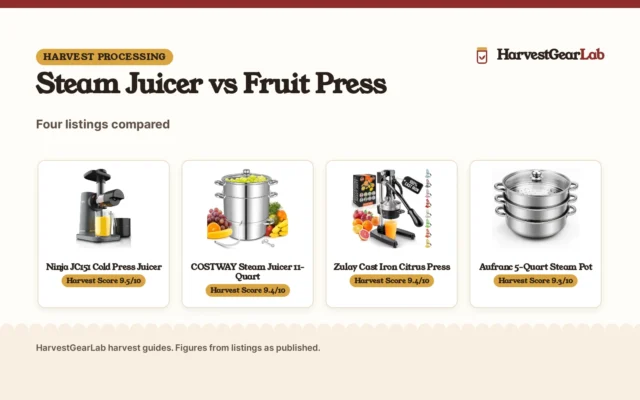
Cider press vs steam juicer comes down to the juice you want: a cider press crushes and presses raw apples for fresh, uncooked juice in volume, while a steam juicer steams the fruit so the juice drips out already heated and ready to store. Pick the press for fresh cider from a big harvest, and pick the steam juicer for cooked juice with less work.
Runners-up to consider
 Elite Gourmet EJX600 BPA-Free Cold Press JuicerCheck price on Amazon
 Ninja NeverClog Cold Press JuicerCheck price on Amazon
 Breville 800CPXL Citrus Press Pro Juicer MachineCheck price on Amazon
 Nama J2Check price on Amazon
 Breville BCP600SILCheck price on Amazon
 Hurom H400 Cold Press Juicer MachineCheck price on Amazon
HarvestGearLab earns a commission when you buy through links on this site, at no extra cost to you. As an Amazon Associate I earn from qualifying purchases. Affiliate disclosure.
What a cider press does
A cider press squeezes juice from crushed apple pulp. The EJWOX listings offer 1.6, 3.2 and 4.75-gallon beech wood baskets, plus a 3.69-gallon stainless steel press at 33.1 pounds. The press is manual: load crushed fruit, turn the handle, and juice flows from the spout. A filter bag keeps the pulp out of the juice; the EJWOX bag fits its 3.2-gallon press, and the bellamei 22 by 26 inch 250-micron bag holds up to 20 lbs.
What a steam juicer does
A steam juicer stacks three parts: water on the bottom, a juice collector in the middle and a fruit basket on top. Heat turns the water to steam, the steam softens the fruit, and juice drips into the collector, already heated. There is no crushing and no pressing. It suits cooks who want juice ready to store without a separate heating step.
Cider press vs steam juicer: side by side
| Cider press | Steam juicer | |
|---|---|---|
| Juice type | Fresh, uncooked | Heated during extraction |
| Batch size | 1.6 to 4.75 gallons per EJWOX basket | Basket by basket |
| Prep | Crush apples first | Load whole or halved fruit |
| Power | Manual | Stovetop heat |
Apples must be crushed before pressing
A press squeezes pulp, not whole fruit. The EJWOX 7-liter crusher processes 35 to 45 kg of fruit per hour into uniform pieces for the press, and the 12.5-pound unit mounts on a table. A steam juicer skips this step entirely, since steam does the softening.
Which one fits your harvest
Count the apples and name the juice. A tree or two of drops means tens of pounds, which the EJWOX crusher turns into pulp at 35 to 45 kg per hour for the press. A few bags from the store mean a steam juicer or even the TUUMIIST cold press juicer, whose 5.8-inch chute takes whole fruit at 55 RPM. For safe juice handling guidance, check current USDA and National Center for Home Food Preservation resources.
Size the press to the harvest
The EJWOX press listings come in 1.6, 3.2 and 4.75-gallon beech wood baskets, plus a 3.69-gallon stainless steel press that weighs 33.1 pounds. A 1.6-gallon basket suits a first season or a single tree; the 4.75-gallon basket suits a big harvest where you want fewer loads. The stainless 3.69-gallon press sits between them on capacity and lists food-grade 304 stainless steel in its materials. Match the basket to the apples you actually pick: an oversized press for a small harvest just means more cleaning for the same juice.
The crusher matters as much as the press. The EJWOX 7-liter crusher is a manual grinder with a large flywheel handle, a 12.5-pound unit that mounts on a table and processes 35 to 45 kg of fruit per hour into uniform pieces. Both crusher listings describe food-grade 304 stainless steel construction. A crusher that keeps up with the press means the pulp never waits; a slow crusher means the press sits idle.
Bags and small-batch gear
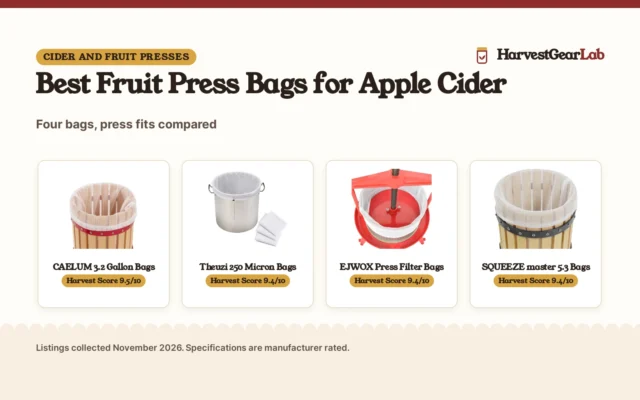
Press bags keep pulp out of the juice. The EJWOX filter bag comes as a 2-pack sized for its 3.2-gallon press, and the bellamei bag is a 22 by 26 inch 250-micron nylon mesh bag with a drawstring that holds up to 20 lbs and fits kettles up to 17 inches in diameter. Both are washable and reusable, per their listings.
For small batches, the TUUMIIST cold press juicer takes a different path: a 5.8-inch chute that takes whole fruit at 55 RPM, 300 watts, 3.8 pounds, with BPA-free materials stated. It suits a few bags of apples rather than a treeful, and it needs no crusher at all.
FAQ: preserving at home
Does a steam juicer cook the juice?
Yes. The steam heats the fruit as the juice extracts, so the juice comes out heated. A cider press makes uncooked juice.
Can you press whole apples in a cider press?
No. Apples must be crushed first. The EJWOX crusher listing describes grinding fruit into uniform pieces for pressing.
How much can a home cider press hold?
The EJWOX listings offer 1.6, 3.2 and 4.75-gallon baskets, plus a 3.69-gallon stainless press.
Which needs less equipment?
A steam juicer needs the juicer and a heat source. A cider press needs the press plus a crusher, such as the 7-liter EJWOX unit.
More preserving guides
See every cider and fruit press guide and all harvest and processing guides.
More picks: cider press vs fruit press, steam juicer vs steam canner and tomato strainer vs juicer.