
On this page
Top picks at a glance
As an Amazon Associate I earn from qualifying purchases.
- 1
 Cuisipro Deluxe Stainless Steel Food Mill9.7/10View on Amazon
- 2
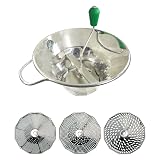 Louis TellierView on Amazon
- 3
 Weston Deluxe Electric Tomato StrainerView on Amazon
- 4
 OXO Good Grips Stainless Steel Food Mill For Purees 2.3 QtView on Amazon
- 5
 Hungry Artisan 3-Disc Food Mill for ApplesauceView on Amazon
- 6
 Küchenprofi Stainless Steel Food MillView on Amazon
- 7
 Mirro 50024 Foley Stainless Steel Healthy Food Mill CookwareView on Amazon
The grape harvest is in and the jelly jars are waiting, which is when the food mill vs jelly bag question stops being theory. The short answer: a food mill pushes cooked fruit through a perforated disc to separate skins and seeds fast, while a jelly bag drips juice through cloth slowly for the clearest jelly. Use the mill for speed and volume, the bag for clarity, and many jelly makers use both in sequence.
Runners-up to consider
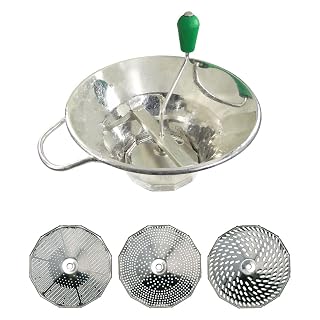 Louis TellierCheck price on Amazon
 Weston Deluxe Electric Tomato StrainerCheck price on Amazon
 OXO Good Grips Stainless Steel Food Mill For Purees 2.3 QtCheck price on Amazon
 Hungry Artisan 3-Disc Food Mill for ApplesauceCheck price on Amazon
 Küchenprofi Stainless Steel Food MillCheck price on Amazon
 Mirro 50024 Foley Stainless Steel Healthy Food Mill CookwareCheck price on Amazon
HarvestGearLab earns a commission when you buy through links on this site, at no extra cost to you. As an Amazon Associate I earn from qualifying purchases. Affiliate disclosure.
Food mill vs jelly bag: the short answer
A food mill is a cranked tool with interchangeable discs that presses cooked fruit through holes of a set size: the Louis Tellier N.3 lists 1.5, 2.5 and 4 mm discs with a 5-quart capacity and up to 3.3 pounds per minute, while the Norpro lists a 2-quart stainless mill. A jelly bag is a cloth bag that hangs and drips juice by gravity, with no cranking and no discs. The mill gives you pulp and juice in minutes; the bag gives you clear juice in hours. For jelly, clarity wins, so the bag usually finishes the job the mill starts.
How a food mill works
A food mill sits over a bowl or pot while a hand crank sweeps a blade across a perforated disc, pressing pulp through and holding back skins and seeds. Disc size sets the texture: the Chencheerio lists fine 3 mm, medium 5 mm and coarse 8 mm discs, and the CANAM IMPERIAL lists fine, medium and coarse discs for sauce, puree and mashed potatoes. The Louis Tellier N.5 lists double milling action at up to 11 pounds per minute with an 8-quart capacity for big batches. Electric strainers scale further: the VEVOR lists 800 watts max with a rated 300 watts, 88 pounds per hour and four screens from 1 to 6 mm. A mill shines when the harvest is large and time is short.
How a jelly bag works
A jelly bag hangs from a stand or hook while cooked fruit drips through cloth by gravity alone. There is no crank, no disc and no pressure, which is the whole point: gravity pulls the juice through slowly and leaves the pulp and sediment behind, producing the clearest juice for jelly. The trade is time and volume, since a bag holds far less than the 5-quart Louis Tellier and drips for hours rather than minutes. For the juicing-first approach, compare with steam juicer vs jelly bag.
Food mill vs jelly bag for clear jelly
For the clearest jelly, the bag wins. A food mill pushes pulp through its discs, and even the fine 1.5 mm disc of the Louis Tellier N.3 passes some solids that cloud the juice. The bag passes only what gravity pulls through cloth. Many makers run the fruit through the mill first for speed, then drip the juice through the bag for clarity. If you want one tool only and jelly is the goal, start with the bag.
Food mill vs jelly bag for speed and volume
For speed and volume, the mill wins. The Louis Tellier N.5 lists up to 11 pounds per minute, and the VEVOR electric lists 88 pounds per hour, while a jelly bag drips at gravity’s pace. The Kitchen Crop sauce maker lists a 1.3 mm screen with a 4.3-pound clamp-on body for steady cranking through bushels. When the counter is buried in tomatoes or apples, the mill clears the pile; the bag would take all day. For mill comparisons, see food mill vs tomato strainer and our best food mill for pears roundup.
Which one should you buy?
Buy the food mill if you process bushels of fruit for sauce, puree and canning, and add a jelly bag when clear jelly is on the list. Buy the jelly bag first if jelly is the only goal and the harvest is small. The mill costs more counter space and more money; the bag costs time. Two of the listings state warranty terms: the Kitchen Crop lists a 5-year warranty and the Cuisinart lists a limited 18-month warranty, if the mill route appeals.
FAQ: preserving at home
Can a food mill replace a jelly bag?
For pulp and sauce, yes; for clear jelly, no. The mill passes some solids through its discs, while the bag drips only clear juice by gravity.
Which food mill is quickest?
The Louis Tellier N.5 lists up to 11 pounds per minute, and the VEVOR electric lists 88 pounds per hour. The N.3 lists up to 3.3 pounds per minute.
Do I need to cook the fruit first?
The listings are built for cooked fruit: the CANAM IMPERIAL and Chencheerio state their mills work with cooked, soft foods. Jelly bags also take cooked fruit for dripping.
Which disc size suits jelly?
The fine discs suit jelly prep: 1.5 mm on the Louis Tellier N.3 and 3 mm fine on the Chencheerio. Finer discs pass less pulp for clearer juice.
More preserving guides
See every food mills guide and all harvest processing guides.
More picks: best food mill for pears, food mill vs immersion blender, food mill vs food processor and steam juicer vs jelly bag.