
On this page
Top picks at a glance
As an Amazon Associate I earn from qualifying purchases.
- 1
 Cuisinart 3-Piece Stainless Steel Mesh Strainer Set9.6/10View on Amazon
- 2
 New Star Foodservice 10-Inch Chinois Mesh Strainer9.6/10View on Amazon
- 3
 Eleen 3-Piece Stainless Steel Fine Mesh Strainer Set9.5/10View on Amazon
- 4
 Louis TellierView on Amazon
- 5
 OXO Good Grips Stainless Steel Food Mill For Purees 2.3 QtView on Amazon
- 6
 Hungry Artisan 3-Disc Food Mill for ApplesauceView on Amazon
- 7
 Küchenprofi Stainless Steel Food MillView on Amazon
- 8
 Mirro 50024 Foley Stainless Steel Healthy Food Mill CookwareView on Amazon
Food mill vs sieve comes down to the job: a food mill mashes cooked produce and strains it at the same time, holding back skins and seeds, while a sieve strains liquids or sifts dry goods by hand. We explain both step by step below, with figures from mill and strainer listings.
Runners-up to consider
 Louis TellierCheck price on Amazon
 OXO Good Grips Stainless Steel Food Mill For Purees 2.3 QtCheck price on Amazon
 Hungry Artisan 3-Disc Food Mill for ApplesauceCheck price on Amazon
 Küchenprofi Stainless Steel Food MillCheck price on Amazon
 Mirro 50024 Foley Stainless Steel Healthy Food Mill CookwareCheck price on Amazon
HarvestGearLab earns a commission when you buy through links on this page, at no extra cost to you. As an Amazon Associate I earn from qualifying purchases. Affiliate disclosure.
Food mill vs sieve: the short answer
Choose a food mill when you process cooked tomatoes, apples or potatoes into sauce and want skins and seeds removed in one pass. Choose a sieve when you only need to strain a liquid, rinse a grain, or sift a dry ingredient. Mills are built for batch work: the Louis Tellier N.5 listing states up to 11 lbs per minute and an 8-quart capacity, while the N.3 states 5 quarts and up to 3.3 lbs per minute.
What a food mill does
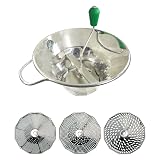
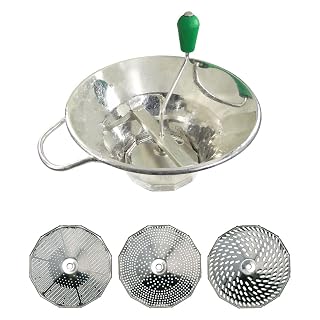
A food mill is a rotary hand-crank tool that presses cooked produce through a perforated disc. The blade pushes the pulp through while skins and seeds stay behind. Discs set the texture: the Louis Tellier N.3 ships with 1.5, 2.5 and 4mm discs, the Chencheerio with 3, 5 and 8mm discs, and the Louis Tellier N.5 with a 3mm disc. The Norpro listing states a 2-quart capacity in stainless steel and notes the mill comes apart for easy cleaning. Clamp-style strainers like the Johnny Apple Sauce Maker work the same way with a 1.3mm screen and a 6-3/4 in spiral, plus a stated 5 year warranty. Compare strainer types in our food mill vs tomato strainer guide.
| Listing | Form | Disc or screen sizes | Capacity or throughput |
|---|---|---|---|
| Louis Tellier N.3 | Hand-crank mill | 1.5, 2.5, 4mm | 5 qt, up to 3.3 lbs/min |
| Louis Tellier N.5 | Hand-crank mill | 3mm | 8 qt, up to 11 lbs/min |
| Norpro | Hand-crank mill | Not stated | 2 qt |
| Chencheerio | Hand-crank mill | 3, 5, 8mm | Not stated |
| VEVOR electric strainer | Electric | 1, 1.5, 3, 6mm | 88 lbs/h |
| Johnny Sauce Maker | Clamp strainer | 1.3mm screen | 5 year warranty |
What a sieve does
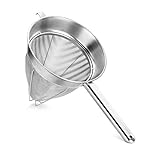
A sieve is a simple mesh screen in a frame. It has no crank and no moving parts: you press or pour through it by hand. Sieves suit straining stock, rinsing rice, or sifting flour, jobs where there is nothing to separate except a liquid or a lump. For cooked tomato sauce with skins and seeds, a sieve works but takes far longer than a mill, because you press everything through by hand.
Discs, screens and mesh
Mill discs run 1.5 to 8mm across the listings. Fine discs make coulis and baby food; coarse discs make rustic mashed potatoes and thick purees. The VEVOR electric strainer ships 4 screens from 1mm to 6mm and states 88 lbs per hour, which suits large-batch canning. The Johnny listing offers optional screens for salsa, pumpkin and berries. Swap discs to change texture instead of buying another tool.
Capacity and throughput
Hand-crank mill capacities run 2 to 8 quarts in these listings. Throughput ranges from 3.3 lbs per minute on the N.3 to 11 lbs per minute on the N.5. The electric VEVOR states 88 lbs per hour for continuous sauce making. If you process a full harvest in a weekend, the larger capacity and higher throughput pay off; for a few quarts of applesauce, the 2-quart Norpro is enough. See our best food mill for canning guide for batch picks.
Cleaning and care
The CANAM, Chencheerio, Compralo and Norpro listings state dishwasher-safe or easy-disassembly cleaning. The Louis Tellier mills use tinned steel and ask for hand washing with drying right away to protect the tin coating. Food-grade stainless steel on the other mills resists fruit acids without special care.
What this guide does not cover
This guide compares food mills and sieves only. It does not cover electric grinders, jelly bags or immersion blenders. Check disc sizes against your recipes before buying, and wash tin-coated mills promptly after use.
In the Harvest Kitchen
- Mill only fully cooked soft produce; the Chencheerio listing warns against raw produce.
- Dry tinned steel mills right away to protect the tin coating.
- Match the disc to the dish: fine for coulis, coarse for rustic mashes.
- Handle sharp edges with care during assembly.
FAQ: preserving at home
Can a food mill replace a sieve?
For cooked produce with skins and seeds, yes. For straining liquids or sifting dry goods, a sieve is the simpler tool.
What disc sizes do food mills use?
The listings state 1.5 to 8mm across the mills, plus 1.3mm on the Johnny strainer screen.
Which mill processes the most per minute?
The Louis Tellier N.5 at up to 11 lbs per minute with an 8-quart capacity.
Do any listings state a warranty?
The Johnny Apple Sauce Maker states a 5 year warranty.
More preserving guides
See every harvest processing guide and all kitchen guides. Also see our food mill vs jelly bag. Also see our food mill vs food processor. Also see our food mill vs tomato strainer.
More picks: food mill vs immersion blender, best food mill for canning.