
On this page
Top picks at a glance
As an Amazon Associate I earn from qualifying purchases.
- 1
 Cuisinart 3-Piece Stainless Steel Mesh Strainer Set9.6/10View on Amazon
- 2
 New Star Foodservice 10-Inch Chinois Mesh Strainer9.6/10View on Amazon
- 3
 Eleen 3-Piece Stainless Steel Fine Mesh Strainer Set9.5/10View on Amazon
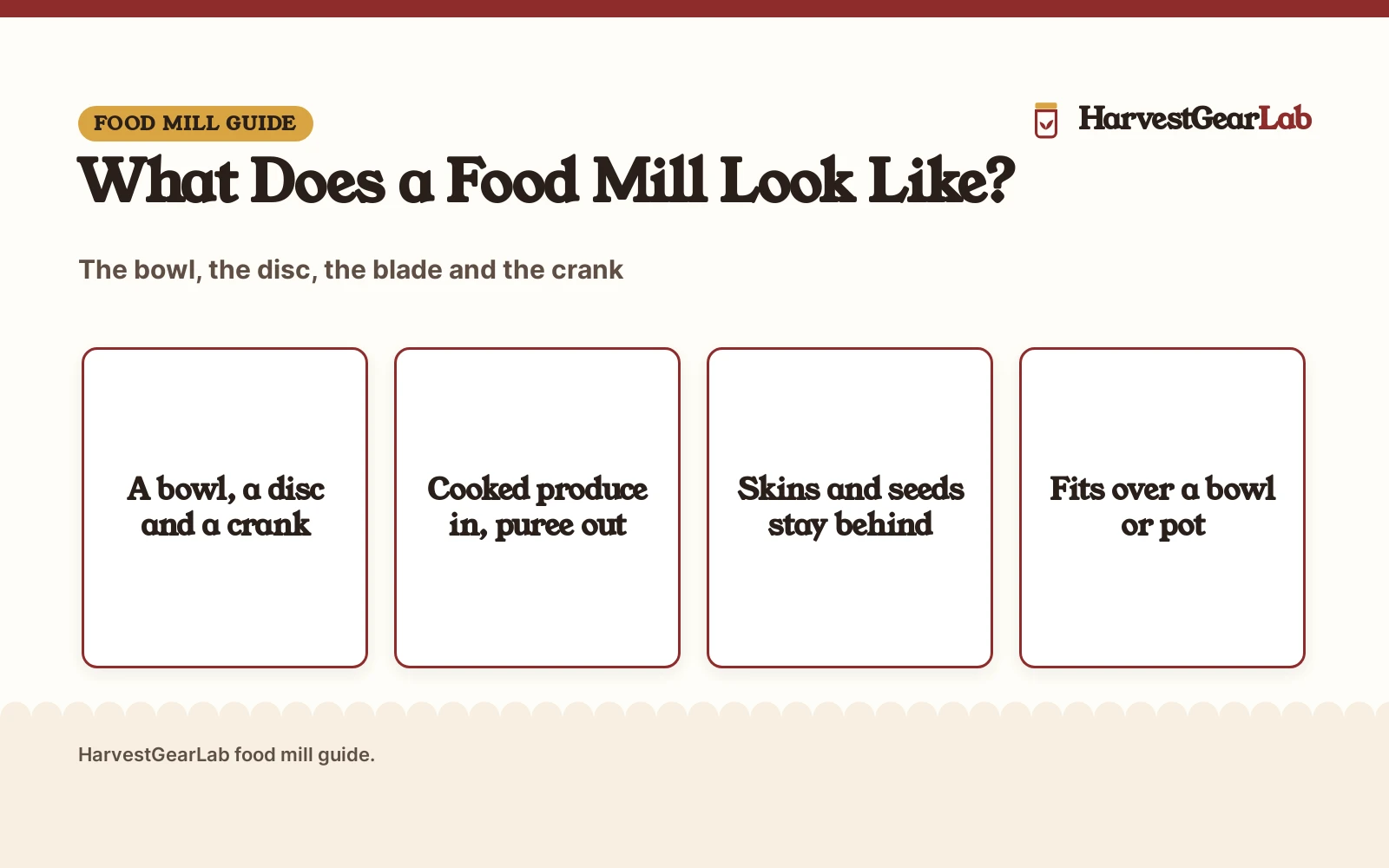
A counter full of tomatoes waits for sauce, and a sieve would take all afternoon. What does a food mill look like? Picture a wide metal bowl with a hand crank on top, a perforated disc inside and a blade that turns under the crank, all sitting on legs that straddle a pot or bowl. Cooked tomatoes go in the top, the crank turns, and smooth sauce falls through while skins and seeds stay behind.
HarvestGearLab earns a commission when you buy through links on this site, at no extra cost to you. As an Amazon Associate I earn from qualifying purchases. Affiliate disclosure.
What does a food mill look like: the short answer
A food mill has a small set of parts, and each part has a job. The table shows what each part looks like and what it does.
| Part | What it looks like | What it does |
|---|---|---|
| Bowl | A wide, shallow metal bowl with a rim | Holds cooked produce while the blade works it |
| Perforated disc | A flat metal plate with small holes, set in the bottom of the bowl | Lets puree through and holds skins and seeds back |
| Blade | A curved blade that turns under the crank | Presses and scrapes produce across the disc |
| Crank | A handle on top that turns by hand | Turns the blade when you crank it |
| Legs or hooks | Legs or hooks under the bowl | Hold the mill over a pot or bowl so puree can fall through |
The bowl and the crank
The bowl is the part you notice at a glance: wide and shallow, with a rim that keeps cooked produce inside while you work. The crank sits on top, with a handle you turn by hand. As the crank turns, it drives the blade below.
The discs and the blade
Inside the bowl, a perforated disc sits at the bottom, and the blade sweeps across it. Discs come with holes in different sizes: fine holes give a smooth puree, and larger holes give a coarser texture. To change the texture, swap the disc for another with holes that match the result you want. The blade presses soft, cooked produce against the disc and scrapes it across the holes, so the puree falls through and the skins and seeds stay in the bowl.
How it sits over a bowl or pot
A food mill needs somewhere for the puree to fall, so it sits above the pot or bowl that catches it. Legs under the bowl straddle the rim of the pot, and some mills use hooks that catch the rim instead. Set the mill steady before you load it, and put a bowl or pot under it that leaves room for the puree. When the mill sits level, the crank turns without wobble and the puree falls clean into the bowl below.
What comes out and what stays behind
Soft, cooked produce goes in the top, and puree comes out the bottom. Tomato sauce, applesauce, mashed vegetables and smooth soups all pass through the disc, while skins, seeds and stems stay in the bowl with the pulp. Scrape the pulp back into the bowl and crank again to get the most from each batch, then tip the dry skins and seeds out when the bowl is empty. For big sauce batches, see our best food mill guide.
Food mill or sieve
A sieve and a food mill do similar work, but the mill does the pressing for you. With a sieve, you push soft produce through mesh with a spoon, and your arm does all the work. With a mill, the crank turns the blade, and the blade does the pressing while you guide the produce. For a pot of sauce, the mill strains out skins and seeds with less effort than a sieve, and the puree comes out smoother. A sieve still suits a small amount, and it stores flat in a drawer. See our food mill vs sieve comparison for the full side-by-side.
FAQ: preserving at home
Can a food mill handle uncooked fruit?
No. Cook the fruit or vegetables until soft, then mill them. A mill presses soft produce through the disc, and hard pieces will not pass through.
Do food mills come with extra discs?
Many mills include discs with different hole sizes, so you can choose a smooth or coarse texture. Check which discs come with the mill before you buy.
What is the difference between a food mill and a food processor?
A food mill presses cooked produce through a perforated disc and leaves skins and seeds behind. A food processor chops everything together with blades, so skins and seeds stay in the mix. See our food mill vs food processor comparison.
How do I clean a food mill?
Take the mill apart, rinse the bowl, disc and blade, and wash them with warm soapy water. Dry each part before you put the mill away, and check the maker guidance for parts that should not soak.
Can I use a food mill for tomato sauce?
Yes. Cook the tomatoes until soft, then mill them: the sauce passes through the disc and the skins and seeds stay behind. See our how to use a food mill for tomatoes guide for the full method.
More preserving guides
See every food mills guide and all harvest and processing guides.
More picks: best food mill, food mill uses, manual food mill and canning tool kits.