
On this page
Top picks at a glance
As an Amazon Associate I earn from qualifying purchases.
- 1
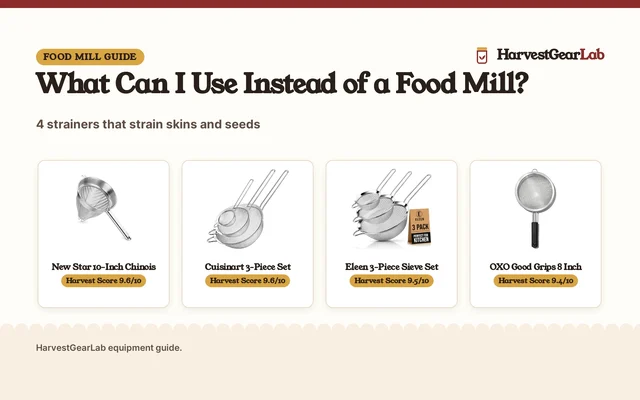
 Cuisinart 3-Piece Stainless Steel Mesh Strainer Set9.6/10View on Amazon
- 2
 New Star Foodservice 10-Inch Chinois Mesh Strainer9.6/10View on Amazon
- 3
 Eleen 3-Piece Stainless Steel Fine Mesh Strainer Set9.5/10View on Amazon
A counter full of cooked tomatoes waits for the pot, and the job ahead is turning the batch into sauce without picking out skins and seeds by hand. Food mill uses cover that job and more: the mill presses cooked food through a disc, holds back skins and seeds, and leaves a smooth puree ready for the pot or the jar. This guide walks through the jobs a food mill handles, how the disc sets the texture, and how to match the mill to the pot it rests on.
HarvestGearLab earns a commission when you buy through links on this site, at no extra cost to you. As an Amazon Associate I earn from qualifying purchases. Affiliate disclosure.
Food mill uses: the short list
Most food mill jobs fall into a small set of uses. The table shows each one, what the mill does, and the foods it suits.
| Use | What the mill does | Foods |
|---|---|---|
| Tomato sauce | Presses cooked tomatoes through the disc and holds back skins and seeds | Cooked tomatoes |
| Applesauce and compotes | Turns cooked apples into a smooth puree | Cooked apples |
| Mashed potatoes | Presses cooked potatoes into a smooth mash | Cooked potatoes |
| Soups and coulis | Strains cooked vegetables into a smooth base | Cooked vegetables |
How a food mill works
A food mill works by pressing cooked food against a perforated disc. The blade turns and pushes the soft food through the holes while skins and seeds stay behind in the basket. The Louis Tellier N.5 (on Amazon) uses double milling action, pressing food against both the bottom and the sides of the basket-shaped disc, and the listing states it processes up to 11 lbs (5 kg) per minute. The disc that comes with the mill sets the texture: the included 3 mm disc suits purees, soups and compotes, and 4 more discs, sold separately, let you adjust the texture for sauces, coulis and finer purees.
Size the mill to the pot it rests on. The Louis Tellier N.5 rests on pots and bowls from 10-1/4 in to 24 in in diameter, with an 8-quart capacity. A mill that spans the pot stays steady while you turn the handle, and the ergonomic handle gives a comfortable grip during long prep sessions. The mill is stainless steel that needs little maintenance.
Tomato sauce, the classic job
Tomato sauce is the job most home canners buy a food mill for. Cooked tomatoes go through the mill, the skins and seeds stay behind, and the sauce comes out smooth without a separate straining step. The puree that comes through is ready for the pot, with the skins and seeds left in the basket.
A mill earns its place when the tomato harvest is large. The Louis Tellier N.5 lists up to 11 lbs (5 kg) per minute, which suits big-batch cooking for restaurants, caterers and home cooks putting up a large harvest. See the best food mill for tomato sauce guide for listings sized for sauce batches, or compare mills in the best food mill guide.
Applesauce, compotes and fruit purees
Cooked apples pass through the disc into a smooth puree, and the mill holds back skins and seeds. The 3 mm disc that suits purees and soups works for compotes too, and a finer disc gives a smoother result for sauces and coulis. The mill strains out the skins on its own.
Fruit purees from the mill work for sauces, coulis and compotes alike. The texture comes from the disc, not from extra straining, so pick the disc that matches the finish you want and keep the rest of the set together. For the difference between a mill and a strainer on fruit work, see the food mill vs fine mesh strainer comparison.
Mashed potatoes and root vegetables
Cooked potatoes pass through the disc and come out as a smooth mash, and the mill holds back any skins. Cook the potatoes until soft before milling, and work them through while they are still warm so the puree stays smooth. The mill also handles other cooked root vegetables the same way, pressing the soft flesh through the disc and leaving skins behind.
For a large pot of potatoes, the disc sets the texture and the skins never reach the bowl. The N.5 comes with a 3 mm disc for purees, and the handle gives a comfortable grip during long prep sessions. For the difference between a mill and a ricer on potato work, see the potato ricer vs food mill comparison.
Soups, coulis and smooth bases
Soups benefit from a mill when the base needs to be smooth. Cooked vegetables pass through the disc, the skins and seeds stay behind, and the strained base goes back to the pot. A coulis works the same way: the mill presses the cooked fruit or vegetable through the disc and leaves a smooth sauce with an even texture.
The disc sets the finish. The included 3 mm disc suits soups and purees, while the additional discs, sold separately, let you adjust the texture for sauces, coulis and finer purees. The mill only changes texture, not flavor.
What a food mill does not do
A food mill needs food that is already cooked and soft. Hard raw vegetables will not pass through the disc, so cook the batch and let the mill do the straining. The mill also will not fix flavor: it changes texture only.
A mill is not a juicer and not a chopper. It will not press juice from raw fruit, and it will not cut food into pieces. For jobs where a processor fits better, see the food mill vs food processor comparison, and for the difference from a tomato strainer, see the food mill vs tomato strainer comparison.
Picking the right size
Match the mill to the batch and the pot. A mill with an 8-quart capacity and a fit from 10-1/4 in to 24 in rests across a wide range of pots, while a mill sized for a small pot suits a smaller batch. Measure the pot before you buy, and check the diameter the listing states.
Throughput matters when the harvest is large. The Louis Tellier N.5 lists up to 11 lbs per minute, which suits big-batch cooking. Compare sizes in the small vs large food mill guide, and see manual options in the manual food mill guide.
Care and storage
Wash the mill by hand after use. The listing recommends hand washing, and the stainless steel needs little maintenance beyond a wash and a dry before storage. Take the disc out for washing so food does not dry in the holes.
Keep the discs together so the set stays complete. The N.5 comes with a 3 mm disc, and 4 more discs are available for other textures, so store them with the mill rather than in a drawer on their own. A dry mill stores well between uses.
FAQ: preserving at home
Can a food mill handle tomato skins and seeds?
Yes. The mill presses cooked tomatoes through the disc while skins and seeds stay behind in the basket, so the sauce comes out smooth without hand straining.
What disc should I use for tomato sauce?
The included 3 mm disc suits purees, soups and compotes, and 4 more discs, sold separately, cover sauces, coulis and finer purees. Pick the disc that matches the texture you want.
Does a food mill work for mashed potatoes?
Yes. Cooked potatoes pass through the disc and come out as a smooth mash, and the mill holds back any skins. Cook the potatoes until soft before milling.
How big a pot does a food mill fit?
It depends on the mill. The Louis Tellier N.5 rests on pots and bowls from 10-1/4 in to 24 in in diameter, so measure the pot before you buy.
Can I use a food mill for applesauce?
Yes. Cooked apples pass through the disc into a smooth puree, and the mill holds back skins and seeds. The disc that suits purees and soups works for compotes too.
More preserving guides
See every food mills guide and all harvest and processing guides.
More picks: food mills for tomato sauce, food mill vs food processor, potato ricer vs food mill and best food mill.